What is Question Mark Wiggle in ASL?
If you see the gloss "QM-wig" or "QMW" -- it is an abbreviation used to refer to a sign called "question mark wiggle." The sign is done by holding up an index finger (also called a 1-handshape) and flexing it a few times so the finger changes back and forth a couple times from a slightly bent index finger to an "x" handshape. In other words "wiggle" the tip of your index finger up and down. This sign is often used with facial expression to add a bit of doubt, incredulousness, or levity to questions. As if to say, "I'm not so sure you are telling me the truth on that." The sign can also be used to simply clarify that you are asking a question or expecting a reply. You shouldn't overuse this sign but occasionally it is helpful.
For example suppose you are asking a Yes/No question such as "IX-[that person] MAD? QM-wig." Doing the sign MAD tends to be done with
furrowed brows doesn't match the typical raised-brows for Yes/No facial grammar. Thus after doing a sign that might tend to use lowered brows such as "MAD" at the end of a sentence -- adding a QM-wig can be used to clarify that you are asking "Is
that person mad?" -- and not stating "That person is mad!"
The QM-wig is used to indicate a specific manual discourse/question signal The notation "QM-wig" isn't used to replace notation for nonmanual question grammar when glossing. A QM-wig is generally used sparingly -- especially to clarify that a complex utterance is a question or to convey skepticism / incredulity -- because eyebrows and other facial grammar normally already indicate question type.
Discussion:
QM-wig refers to a sign called "question mark wiggle." It is used at the end of question
sentences which may be in need of clarification (of the fact that the sentence
is a question) or for responding in a questioning way in which you are also
expressing skepticism.
"Reeeealy?"
"Are you suuuure about that?"
"You wouldn't be pulling my leg would you?"
"Is that so? Hmmm."
QM-wig (repeat the movement a couple times)
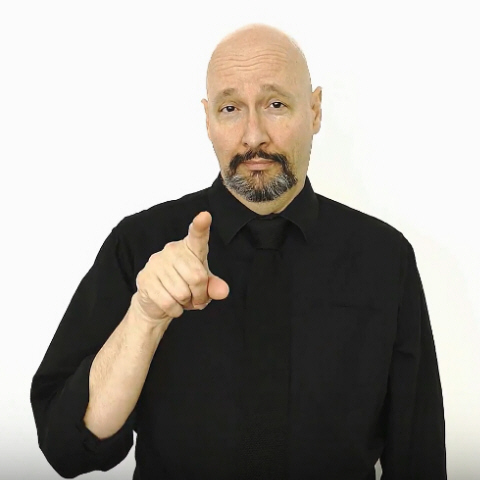
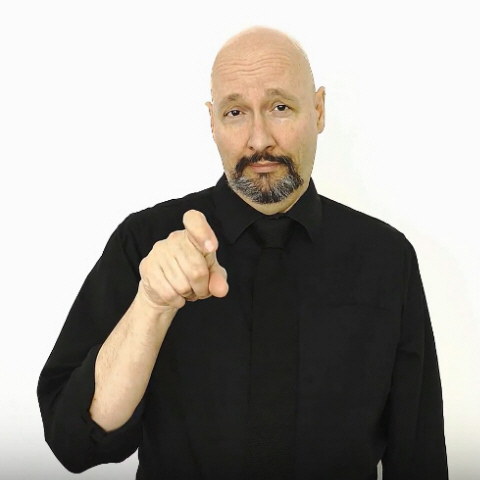
Video clip of "QM-wig"
Or see: https://www.youtube.com/watch?v=kS2VaLVITiw
Notes:
While QM-wig is often used to show skepticism, an example of a time when you
might want to use QM-wig for a question in which you are "not" skeptical but are
simply asking a question is: "Do you think he is mad?" Or "Is he
mad?"
Such a sentence is actually a yes/no sentence which typically uses raised
eyebrows but the sign MAD typically uses furrowed eyebrows. A type of
facial grammar punctuation conflict is created in which the yes/no facial
expression is competing with the MAD facial expression. Compounding the issue is
the fact that the "MAD" facial expression just so happens to use furrowed
eyebrows similar to the furrowed eyebrows used for WH-Questions.
Approaches:
1. Sign MAD with furrowed eyebrows and adjust the sign order: MAD
is-HE?-[y/n-q]
2. Do the sign MAD with a yes/no facial expression: HE MAD?-[y/n-q]
3. Sign MAD with furrowed eyebrows and use a QM-wig: HE MAD
QM-wig?-[y/n-q]
Also, regarding QM-WIG -- If, for some reason, your question sentence ends with conflict between a "sign expression" and a "punctuation expression" you may want to clarify via a QM-wig that you are indeed asking a question. For example, if you ask "Is he/she/that-person sad?"--you tend to end with a sad facial expression rather than the "yes/no question punctuation expression of raised eyebrows. In such situations the face can't be used simultaneously for both the "sad face" and the raised eyebrows. of the yes/no question expression. So you can go ahead and use the sad face but add QM-WIG for the question punctuation with raised eyebrows.
Also see: "Question Mark"
See: ASK-to
Notes:
Where this sign is taught:
Taught in Lesson 28.Reviewed in lessons: 34
Practice sentences using this sign:
SUPPOSE THIS CLASS, YOU SKIP, MUST BRING-to-here EXCUSE QM-wig? (If you are absent from class do you have to bring an excuse?)DURING TEST, CAN TALK QM-wig?
SUPPOSE SHIRT NONE, SHOES NONE, STORE ALLOW YOU ENTER QM-wig?
YOUR MOM STUBBORN QM-wig?
YOUR HOUSE CORNER QM-wig?
HOLLAND HAVE MANY FLOWER QM-wig?
YOU THINK TONIGHT FREEZE QM-wig?
FOOD, IF COVER, WILL POSTPONE RUIN-[spoil] QM-wig?
DURING SIGN-[fluently] ASL SHOULD USE MOUTH QM-wig?