* In this circumstance we are discussing "time out" as in "an imposed temporary
suspension of activities, especially the separation of a misbehaving child from
one or more playmates as a disciplinary measure." (Source: Oxford).
The phrase "time-out"* is a concept the signing of which is strongly influenced
by context and environment. There are a number of common / acceptable
(i.e. "right") ways to sign "time-out."
In environments (such as a school) where there are lots of children engaged in
lots of interactive activities and where the form of the time-out activity is
highly variable (such as sitting in a corner, standing in a corner, sitting on a
bench, standing in a designated area, sitting on the grass in a specified area,
etc.), it is likely that the expression of "time out" will have evolved into or
adopted a very quick (fairly low-effort) signed expression due to its being used
frequently over a long period of time. A sign used by a school will likely not
involve much expansion or specific directives (such as go sit in the corner)
because there may be common situations (in need of a time-out) when a corner is
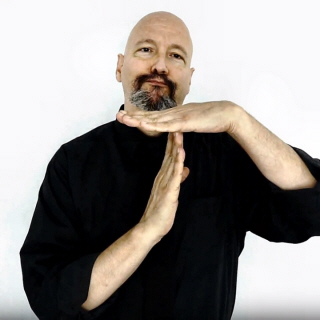
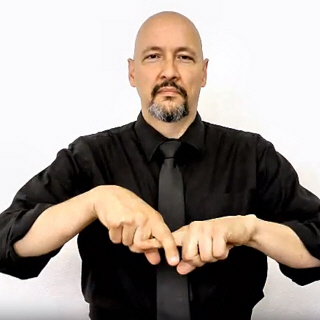
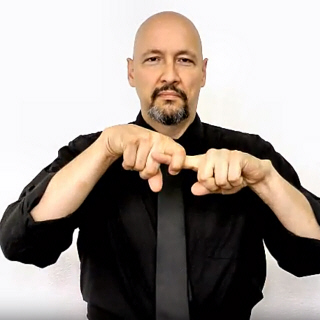
not available. Thus a quick, single sign such as the "TIME-OUT"-[T-sign / sports
gesture] or the PAUSE sign will tend to be popular.
TIME-OUT-[T-sign / sports gesture]
PAUSE:
In smaller or more contained environments such as homes and/or individual
classrooms the concept of "time out" is often more commonly expressed by simply
stating the desired actions associated with a time-out. For example, "GO SIT."
The parent or caregiver does the sign "GO" in the direction of a specific chair
or corner associated with being in a time out. Usually there is no need
for a separate sign for time out in such "high-context" environments. If a
parent stands up, walks over to the table, grabs a chair and places it facing
the corner -- it is pretty obvious to most children that they are being directed
to do a "time-out." If the child hesitates or seems unclear then the
parent starts adding more signs (such as: GO-there SIT!) or even physically
assisting the child to the chair.** Eventually upon being told "GO-[go
there to the corner] SIT!" the child will be expected to get the chair
themselves and sit in the corner (or sit there without a chair).
See:
GO
See: SIT
It is certainly common and acceptable to use various expansive approaches to
creating the meaning of "time-out" by signing such things as FINISH-[one-handed
/ "knock it off"], PAUSE, or STOP and then adding GO BEDROOM or GO CORNER.
See:
BEDROOM
See:
CORNER
It is not uncommon for parents of Deaf children to even do the
"TIME-OUT"-[T-sign / sports gesture] and point toward the corner or bedroom in
which the time-out is to occur.
A separate but related concept is: "To be placed in time-out" and / or "to place
in time out."
The concept of "being placed by authority into a specific situation"
Also see:
OUT
PAUSE
PUNISH
STOP
TIME
TROUBLE
Notes:
* "time out" as in "an imposed temporary suspension of activities, especially
the separation of a misbehaving child from one or more playmates as a
disciplinary measure." (Source: Oxford).
** Ever so gently of course.
Notes: