American Sign Language: "try"
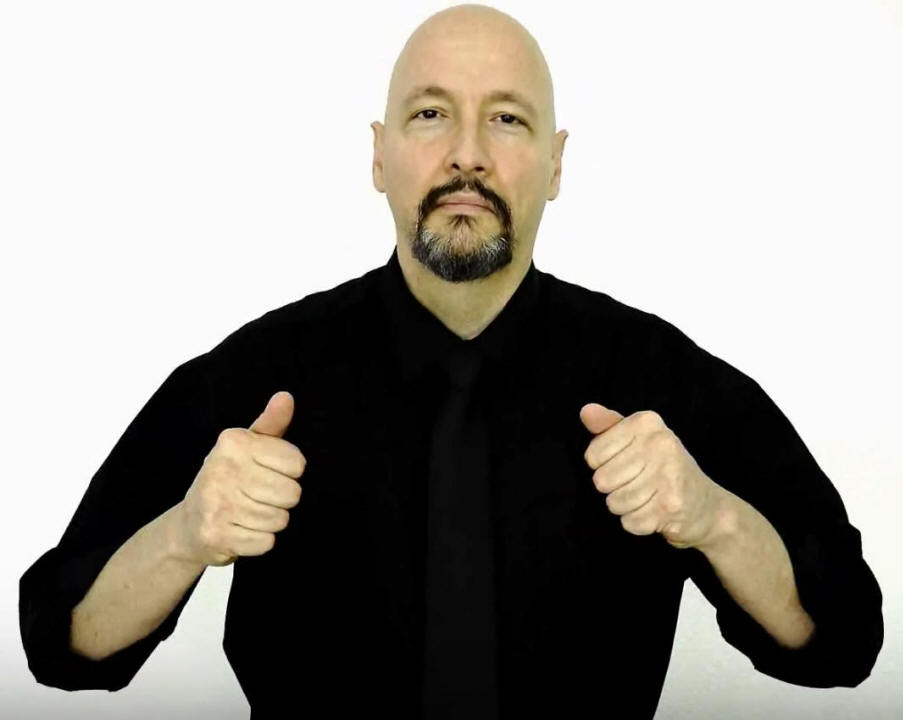
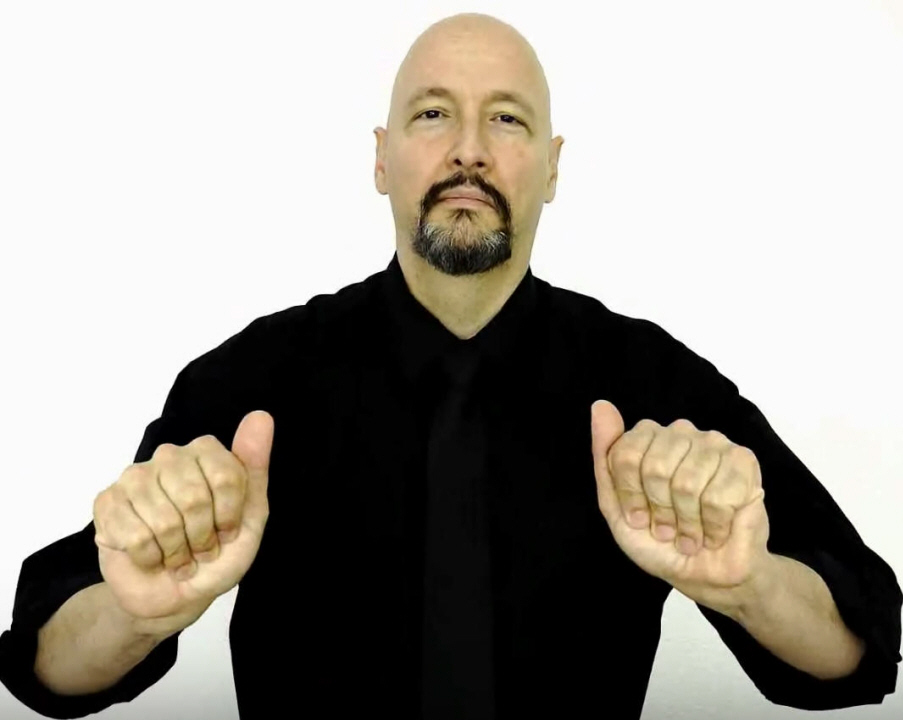
TRY / attempt / make an effort
Usage notes:
The sign for "try" is done several ways in the Deaf Community. If you are taking an ASL class and "trying" to get an "A" then I recommend you check with your local instructor since he or she is the person giving you a grade.
Not so long ago the sign for "try" was often done by placing your hands in "T" handshapes held palm-down, near the body, about the width of your torso apart -- then moving your hands in a slight arc forward and a little upward while bending your wrists so that the front of the "T"-hands (the palm side) is facing facing forward.
Chances if you did it that way these days your ASL instructor would correct you and tell you that if you do the sign TRY by using "T" handshapes that you are doing a "Signed English" version of the sign. At which point the proper response would be to just smile sweetly and thank him or her for knowing everything and for correcting you. From then on in his/her class do the sign with either "S" or "A" handshapes as preferred by your local instructor. Get the grade you want and then go out and see how "Real Deaf" do the sign for TRY in the real world. You will see variations.
Make sure at the end of the semester to carefully fill out the "teacher evaluation" form -- especially any parts that ask about the instructor's "fairness" and his or her "ability to stimulate interest in this subject."
-- Dr. Bill
Notes:
In a message dated 2/2/2007 5:08:03 A.M. Pacific Standard Time, Brenda (bdawe) asks:Hi again... sorry to bother you twice in the same mail run, but I'm not finding the sign for "TRY" on your pages nor on [the other site I looked at]... SO! I need your personal opinion. My ABC/ASL text shows this sign with two "S" hands... The ASL dictionary shows "T" hands and a third resource shows "A" hands (which looks too much like a double handed "ANY"). I asked Walt (my [Deaf] husband and role model) and he uses "T" as I do yet I realize this is also the initialized version of the older ASL sign, but is that any different than using the initials for groups ("TEAM", "FAMILY", etc)
And for the base older version of "try" would it be with "S" or "A" hands?
--Brenda
[Response updated: Fall 2017]
Hi Brenda,
As you very well know, (and have described in your email) throughout the Deaf Community we see the "TRY" sign done several different ways.
You bring up a good point about many commonly accepted signs such as "TEAM" and "FAMILY" being initialized. Such signs are certainly "out there and recognized" in the Deaf Community.
The challenge we (as ASL instructors) face is that we are dealing with several different but overlapping communities, including:
1. The general Deaf Community
2. The ASL Teaching Community
3. The Political Deaf Community
Over time things become "in vogue" (popular or fashionable) within communities.
Sometimes an item, concept, or process will become part of the "zeitgeist" (the defining spirit or mood of a particular period of history as shown by the ideas and beliefs of the time) of one community but not the other communities.
In the "political" and "ASL teaching" communities it is fashionable to shun any initialized signs that are "weakly" anchored.
It is sort of like lions going after and picking off the weaker members of a herd of water buffalo. The initialized sign for TRY is "easy pickings" for the "lions" (folks with one hand over their ear and one fist in the air). For many years that initialized version was my favorite. Then eventually the "A" hand version started gaining very widespread usage and I decided that it would be in the best interests of my students for them to learn the "A"-hand version as their main sign for TRY.
As a community member, you know that you see the initialized form of TRY out there.
As an ASL instructor though you look to your left and you look to your right and you see your colleagues pouncing on hapless students for signing TRY with a "T" and you wonder, "Gee, should I be pouncing too? I don't want to look uncool or like a Hearie." At some point the pouncing becomes so pronounced that lions start pouncing on other lions. At some point a little mental switch flips and an ASL instructor starts to think, "Dang! That does it. I don't care if I see my husband and most of my Deaf friends sign TRY with a 'T' -- I'm going to teach my students to do it with an 'S' or an 'A' because that is the right way."
Then we tell ourselves that it is NOT our job and responsibility to describe to our students how the Deaf Community is signing "TRY" but instead to prescribe to our students how the ASL Teaching Community and some of the political community feel the sign should be done.
And guess what?
If we keep it up--often enough, long enough--eventually there is the likelihood that the prescription will be swallowed and become part of the general Deaf Community. At which point we can pat ourselves on the back and say, "See, we were right." [While our students scratch their heads and try to figure out why their teacher insists this is the "right" way but their friend signs it some "other" way.]
You asked which would be the "base" or "older" version of TRY. I'm pretty sure the older, base version is the "S" version. However, most of the "lions" (hyenas?) seem to currently [as of this 2017 update] be using the "A" version.
So, since you asked, I recommend you teach your students to sign "TRY" using the "A" handshape (or maybe the "S" handshape -- whichever is more common in your local community) and then briefly show your students the other two versions but indicate that in your classroom you prefer "this" version (and repeat your chosen version).
The fact is, language changes over time. Such changes generally start small and spread. If enough people adopt the change it becomes part of the language. Some changes start spreading and then "die out." Some changes spread amongst part of the community (age group, geographical location, social status) but never gain widespread acceptance.
I used to think of people who resisted change (who approached ASL instruction in a "prescriptive" manner rather than a descriptive one) as out of touch "purists" longing for the good old days of "true" ASL while ignoring that language changes and we are doing our students a disservice by teaching them "historical versions of signs" rather than the signs that are being used in today's Deaf Community.
It is a moot point.
While I think that there are many signs that are legitimately initialized such as "YELLOW," "HOSPITAL," and "GOVERNMENT" I think that as an instructor it is best (for my students) if I teach a little on the conservative side (avoiding initialization as much as reasonably appropriate).
My students might end up in a lion's classroom for next semester's class and since I desire to protect my students I'm going to teach them the version that I feel will placate the lion as well as any other versions that show up often in the local Deaf Community. Teaching multiple versions takes longer (duh) and every "version" you teach means less time to teach some other sign so it is important not to become a "version junkie" for the sake of social safety.
It helps to point out on the first day of class that there exists quite a bit of variety out there and that you will focus on teaching a good, solid, version of each sign but that it often isn't the only version of a sign and that students should stay flexible and expect to see other versions of signs from their next instructor and in the Community. Then point out that it is good to learn from different instructors because it better prepares a student for the vast amount of variety in the Deaf Community (thus helping them to eventually become better interpreters -- if that is their job path).
I would also suggest that it is our job as ASL instructors to teach A-S-L, not "neologisms (newly emerging signs) and slang." Such items may be cool, fun, and/or eventually become ASL but until they actually are ASL they should not be taught in basic ASL programs.
Cordially,
Dr. Bill
---------------
Notes:
* I asked Byron Cantrell (Deaf, Deaf School/Georgia, Deaf wife, long-time ASL instructor) and he was very much committed to signing TRY with "S" handshapes. He also felt that all of the various versions of TRY (attempt, strive, etc.) should be done with "S" handshapes with the exception of "EFFORT" which he felt should be signed with "E" handshapes.
* I asked Lauren Smith (Deaf, Deaf School, long-time ASL instructor, Northern California area) and she immediately showed the "S" handshape version.
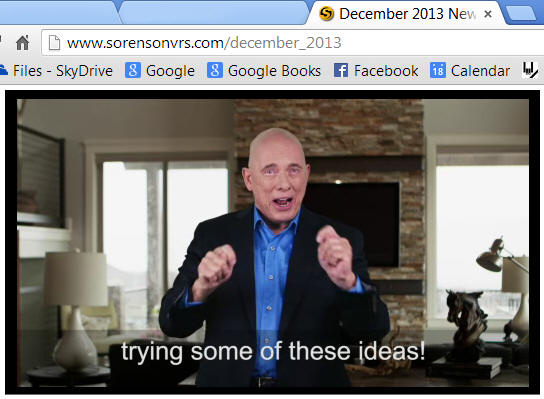
* In the December 2013 edition of the Sorenson Communications VRS Newsletter, Ron Burdett, (Vice President of Community Relations) signed TRY using the initialized version. Thus you have a very respected Deaf individual who is THE top spokesperson for one of THE biggest players (SVRS) in the Deaf world is using an initialized version of the sign TRY in their flagship publication. (See below.)
Source: Burdette, R., (2013) December 2013 Newsletter. SVRS Messenger: Sorenson Communications. Retrieved 19, Dec. 2013: <http://www.sorensonvrs.com/december_2013>
You can learn American Sign Language (ASL) online at American Sign Language University ™
ASL resources by Lifeprint.com © Dr. William Vicars
Want to help support
ASL University? It's easy:
DONATE (Thanks!)
(You don't need a PayPal account. Just look for the credit card
logos and click continue.)
Another way to help is to buy something from the ASLU "Bookstore."
Want even more ASL resources? Visit the "ASL Training Center!" (Subscription
Extension of ASLU)
CHECK IT OUT >
Bandwidth slow? Check out "ASLUniversity.com" (a
free mirror of
Lifeprint.com less traffic, fast access)
VISIT >
