back.gif (1674 bytes)

show

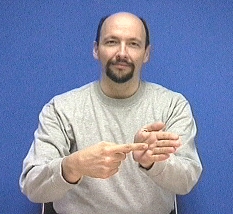
Imagine you have a picture on your palm and are showing it to your friend.

Note:  This sign is directional.  If you start the sign farther way from your body and move it closer to you, it means, "Show me."  If you use a horizontal sweep with this sign it can mean, "Show them," or "Show all of you," depending on how you sweep the sign.

SHOW:  As in, "I want to show you my new puppy."


This version of "show" means the same as the above version. I include it here so you'll see there is more than one "right" way to do this sign.


EXAMPLE:

You can initialize "SHOW" and use it for "example."

Using initialization you could use the letter "D" to mean "demonstrate.  But don't go overboard on initialization.  If you use the word "demonstrate" but it really means show, just use the standard sign for "SHOW."


SHOW-UP


SHOW-UP: (animated)


Note:  If you mean "show" as in, "I want to go to the (movie) show" then you should use the sign MOVIE or ACT.


American Sign Language University ™ ASL resources by Lifeprint.com © Dr. William Vicars
back.gif (1674 bytes)


Optional Reading

In a message dated 6/23/2007 5:30:56 AM Pacific Daylight Time, ndnlittlecrow@gmail.com writes:
Is the sign EXAMPLE directional? I mean if i started it away from me and brought it towards me then would it mean "You show/give me an example"? Or is it not directional and only moves away from the body and only means "example"? The reason I ask is because EXAMPLE is an initialized form of SHOW, so I was wondering if the same "usage rules" applied to initialized forms of words.  
- Roo
Hi Roo,
The word "show" is a verb.  You can establish "verb agreement" via "directionality."  That means you can modify the movement of the sign "SHOW" to indicate who is showing what to whom.
 
The word "example" is a noun thus we do not have the same freedom to employ directionality that we would with a verb.
"Example" is somewhat of a special case though because it does have a rare "verb" form: "exemplify."
So, technically, you could construct a sentence along the lines of, "Would you mind exemplifying that for me?"  Which would make a case for employing directionality with the sign "example."
On a personal level, as I sit here signing to myself, playing with the sign, (my family are used to seeing me "sign to myself" and have long since given up worrying whether it is insanity or some other reason) and seeing what "feels" right--I note that it feels okay to sign "give an example to" as one sign/movement, but it "feels" a little "off" to sign "give me an example" using just one sign/movement but still passable.
Dr. V