American Sign Language: "outside"
"Outside" has several versions.
The right version will depend on whether you are using "outside" as a noun, verb, or adjective.
Version 1:
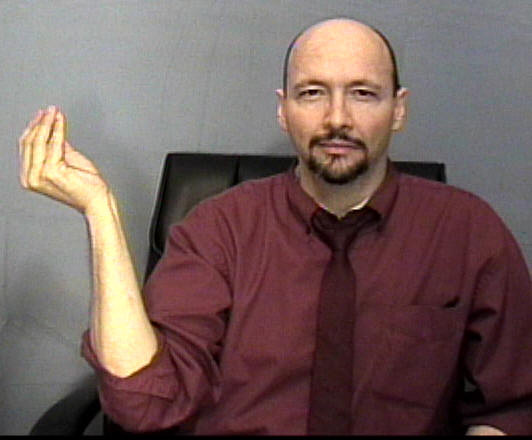
This version of "outside" is generally used as an adjective that means "situated on or pertaining to the outside; exterior; external." (Some people also use this version as a noun to mean "outdoors" -- especially if you do it large like I'm doing it here. But there is another sign that specifically means "outdoors." See further below.)
OUTSIDE (general version)
Version 2:
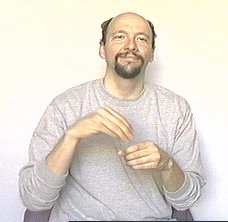
This version uses a quick repeated movement of "to go out." The repeated movement makes it a noun. (If you were to do this movement a little larger, with a bit more of a pause between repetitions, it could mean "to go out repeatedly.") But the way I'm using it here it definitely means: "outside."
OUTSIDE / OUTDOORS:
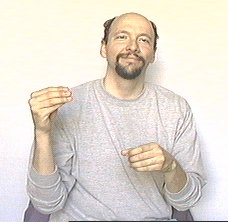
The verb form of this sign means: "GO-OUT" You just do a single movement that aims "up and out" at an angle or does a bit of an arc as I'm doing here. This sign is a larger, higher version of the sign LEAVE.
"GO-OUT"
Note: The fact that "a single movement of this sign is a verb and a double movement of this sign makes it a noun" qualifies this sign as a "noun/verb pair."
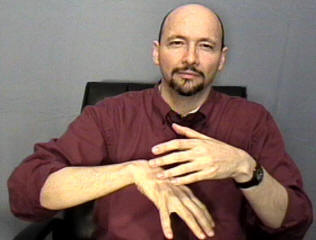
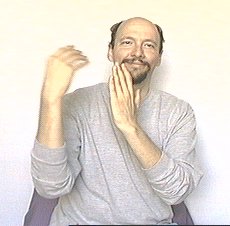
General sign for "OUT."
Used in contexts such as, "I took it out."
(Yah...I know my hair, what little I have, is mussed. Whatever. Pay attention to my hands.)
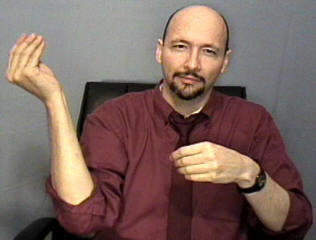
Variation: EXIT (to leave the inside).
This sign is sometimes used to mean "to have left." The use of the base hand indicates having been "in." Walls.
Think of this sign as meaning, "be inside and then leave."
Note: The movement is slightly forward and off to the side. The handshape changes from a loose hand to an "and" hand (squished "O").
"To go out" "He/she is out":
OUT/EXIT: animation
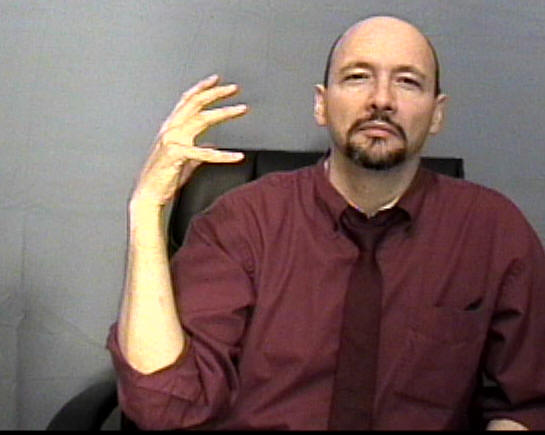
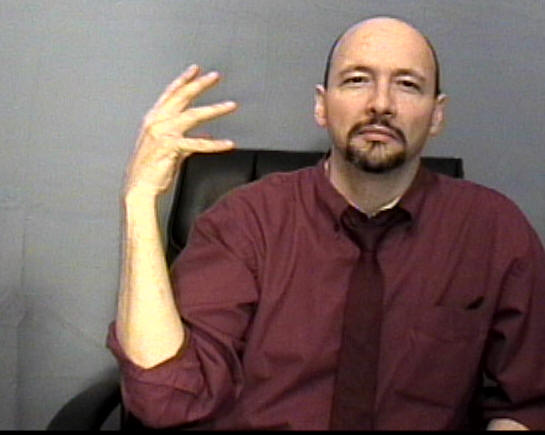
Notice this next variation starts with an "open" hand and closes as it moves out. This open then closed movement is related to influence from the concept of "leave." For more info, see: "LEAVE"
Notes:A colleague (an ASL teacher) writes:... I use only the one handed sign in a repeated motion to show outside. "He is outside." A variation of the sign not repeated combined with a flat palm as shown in your picture is an adjective to show something's out or to go out. My preference is for the verb "to go out" -- is to use one hand sign, instead of two hands.Dr. Bill's response:
Thanks for sharing that. I agree. The one-handed sign for "outside" is indeed a widely used sign and needs to be included on [this] page under the heading of "outside." [fixed]
I think the two-handed variation is worth posting though since it is also in use to mean "outside."
For example as of this writing there is a two-handed version shown at Michigan State University's website that is specifically labeled as "outdoors." [March, 2008]
My current thinking for the "outside" page is to:
1. Show the "single movement one handed version" under the heading of "GO-OUT" and label it as a verb and mention that it is related to a very similar sign: "LEAVE." (And then provide a hyperlink to the "LEAVE" page.)
2. Show a double movement of the one-handed version and label it as "OUTSIDE" and indicate that it is widely used as a "noun" form.3. Show the two-handed version of the general "out/outside" sign and label it as the general sign for "OUT" and explain that some people use it to mean "go out," "outside," and/or "outdoors."
As an instructor in the classroom I like to show my students various sentences so they can get a better feel for the meaning and usage of this sign. For example, when I sign, "Do you want to go out to eat?" I always use the "single movement / one-handed" version of "GO-OUT."
Again, thanks for your input.
-- Dr. Bill
You can learn American Sign Language (ASL) online at American Sign Language University ™
ASL resources by Lifeprint.com © Dr. William Vicars










Want to help support
ASL University? It's easy:
DONATE (Thanks!)
(You don't need a PayPal account. Just look for the credit card
logos and click continue.)
Another way to help is to buy something from the ASLU "Bookstore."
Want even more ASL resources? Visit the "ASL Training Center!" (Subscription
Extension of ASLU)
CHECK IT OUT >
Bandwidth slow? Check out "ASLUniversity.com" (a
free mirror of
Lifeprint.com less traffic, fast access)
VISIT >
