CL:C : The
American Sign Language (ASL) sign for "CL:C / classifier C"
For an explanation of "classifiers" in general, see:
CLASSIFIERS
Note: as you study classifiers on some of these pages I have included signs
which evolved from classifiers but are so now so common and standard that they are
considered just regular signs.
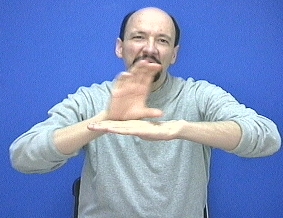
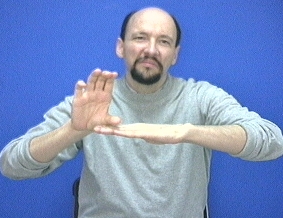
The "C" hand shape can be used to show objects that are classified as "round
and/or cylindrical" (as in a pole). "Classifier C" can also be used to
show thickness
(such as a "thick" book or a layer of snow).
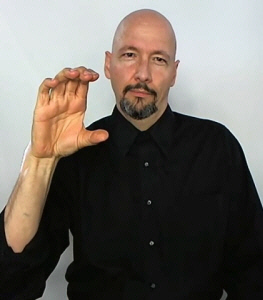
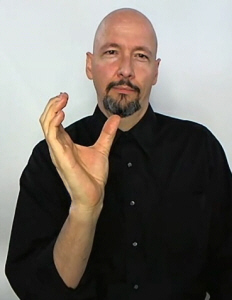
Note: Quite often "Classifier: C" when used to mean "thick" will be used with the mouth morpheme "CHA"
(which means that you might see people's mouths move as if they were saying
"Cha!" while doing the sign).
Think of the "CHA" morpheme as meaning "very" when used with "THICK."
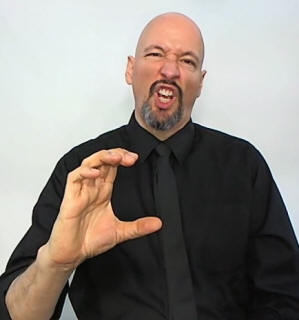
Example of usage of a "Classifier C":
THICK LAYER:
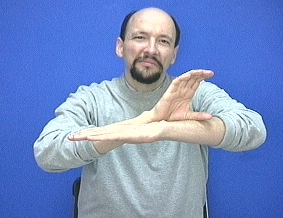
COUNTER ISLAND:
DOTTED:
BINOCULARS:
The sign BINOCULARS is not a classifier. Of course the sign very likely
started as a classifier and then over time became so common that it is just a
regular sign (based on the now frozen classifier). If you change the way
you do the sign to include additional information (for example: miming looking
through binoculars while looking up) you thaw the sign back into a classifier
again and it can be used quickly and efficiently add additional information to
your message.
THICK-CRUST: In context you can use a CL:C to indicate that the
crust on a pizza is a "thick" crust.
Sample sentence: "Which do you prefer, thick or thin crust pizza?" = "PIZZA THIN-[crust], THICK-[crust], WHICH FAVORITE-[prefer] YOU?"
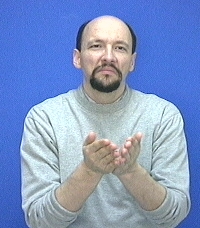
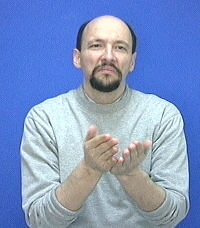
THICK-BOOK:
First you establish that you are talking about a book, then you indicate
that it is "thick."


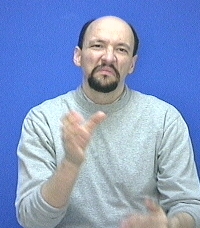
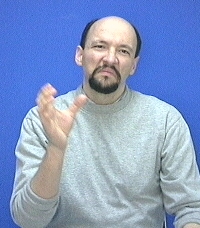
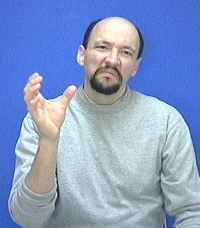
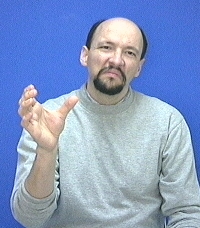
The "freezing" and "thawing" of classifiers.
Over time with repeated, frequent usage, a classifier can become so common as
to starting functioning as if it were just a regular sign.
For example we use a classifier-like depiction to do the sign "ARTICLE" or
"COLUMN (of text or other information)."
However, unless you modify the size or length of the movement, the sign "ARTICLE" is not a classifier. Over time it has become standardized (lexicalized) and is now just a regular sign. But suppose I started the sign a little higher, exaggerated the movement, and brought the dominant hand "way down" to show a "long article"? In that circumstance, it would be a classifier.
Thus many regular signs and classifiers overlap and whether or not we can consider a sign to be a classifier depends on whether or not we are inflecting (changing the way we do the sign) to add more information such as the size, the shape, the way it is moving, or other information.
You can use a CL:C or a modified version that just uses the index finger and
the thumb to indicate an "article" or "column" --
as in, "a newspaper column."
I use a "partial C" handshape, but you could also use a regular "C"
handshape. When I do it with a regular "C" handshape, I am generally
referring to a "chapter" -- as in "a chapter in a book."
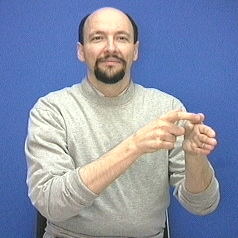
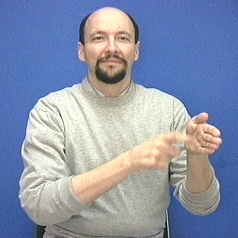
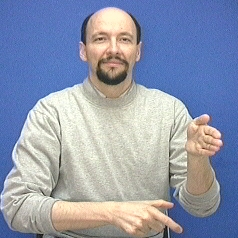
The generic sign for CUP is not a classifier.
But if I use a "C" handshape to show three different cups then you could
start making the argument that I am now using a "classifier C" to
add information (in this case about the number of or positions of the cups) rather than
just doing the sign for "CUP."
This would be especially true if my
non-dominant hand were to be turned downward (as if representing a table or
shelf) instead of upward.
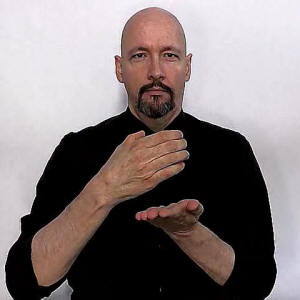
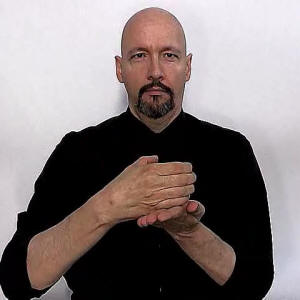
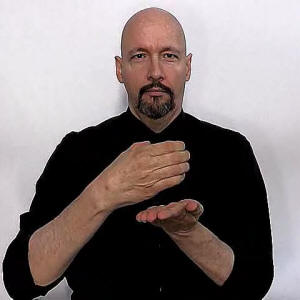
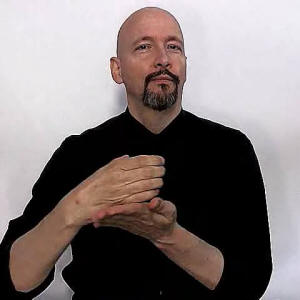

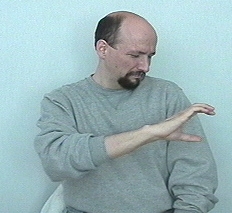
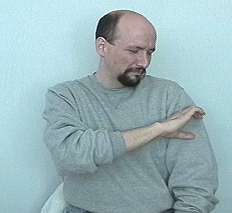
BRUISE:
You can show the location of a bruise.
The regular sign for BRUISE done on the upper arm may or may not be a
classifier. It might just be functioning as a sign for "bruise"
without actually indicating that you have a bruise in that exact spot.
If you do the sign BRUISE in some other location then it is functioning as a
classifier because the change in location of the sign is adding information
(about location or positioning) beyond just the concept of "bruise."
CL:C-claw
CLOWN:
The sign for CLOWN is not a classifier. Or rather at one point in time it
might have been a classifier but over time and with repetition and familiarity
the classifier froze or fossilized into a regular sign for the concept of
"clown" without specifically implying or stating that the referent has a big
nose. For example a person could be the "CLASS CLOWN" and it would simply mean
the person is always joking or clowning around -- not that they have a big nose.
However, if you were to use the sign CLOWN while mouthing as if saying "CHA!" to mean "has a big nose" -- you could start to make the case that the sign is being used as a size and shape specifier type of classifier.
RADIO:
Again, here we see how a classifier has fossilized into becoming just a
regular sign.
If we use Claw-C hands to indicate that someone was wearing "huge" headphones
then we would be using the handshape as a classifier (instead of as a sign for
radio).
GROWL:
The sign for GROWL is not a classifier unless we are using it to depict how a dog (or other animal) was growling.
For example, if we do the sign GROWL near our stomach it would be a type of
locative verb but not actually a classifier representing the teeth of a growling
animal.
COOKIE:
The sign COOKIE is another example of a classifier that was used so often and
for so long that it simply because associated in the minds of people with
cookies in general -- not just those that were cut out by hand in circular
shapes. The claw-C doing a cut-out-a-cookie movement on the palm is a
regular sign until you use it as a way to add information about the cookies.
For example, if you were to use it to compare the process using an individual
cookie cutter to cut out individual cookies vs. making a sheet of cookies and
cutting them into squares with a knife.
BALL:
You can change the sign BALL into a classifier by doing it bigger or smaller or
to indicate the size of the ball. Or you could mime throwing a ball which would
show how the ball is being used.
CL: baby-C
PARROT:
There is a sign for "parrot" that uses a baby-C handshape. You could
change that sign into a classifier and used it to depict a parrot that likes to
bite or that won't shut up.
MOON:
The sign for "moon" is another fossilized classifier. Suppose you were to
position the sign in some other location? That would be you thawing out
the sign and turning it back into a classifier to show the location or movement
of the moon.
SCREW / NAIL:
If you use a baby-C to show the specific length of a screw or nail -- you are
using it as a classifier.
CL:C-flat
DISCOUNT:
Another fossilization of the classifier C is that of signs like "DISCOUNT."
The sign DISCOUNT is not a classifier but rather it is a sign that may have
begun its existence as a classifier and then transitioned into simply meaning
"discount" when used in a fitting context.
The C hand however can easily function as a classifier be used to depict
something deflating or becoming less.
PEA-BRAIN:
The sign PEA-BRAIN is not a classifier but suppose you used a similar sign to
indicate the actual size of a brain? Maybe you were comparing the size of
a small animal's brain to that of a human? Or maybe you might want to use
this handshape to describe the size of a tumor in the brain?
EMAIL:
The version of the sign EMAIL that uses a flattened C hand is not a
classifier but probably started out as a classifier attempting to show
electronic communication going to and from a router or other electronic device
and eventually turned into a regular sign.
Notes: Also see: CLASSIFIERS
Also see: THICK
*
Want to help support ASL University? It's easy:
DONATE (Thanks!)
* Another way to help is to buy something from Dr. Bill's "Bookstore."
* Want even more ASL resources? Visit the "ASL Training Center!" (Subscription
Extension of ASLU)
* Also check out Dr. Bill's channel:
www.youtube.com/billvicars
You can learn American Sign Language (ASL) online at American Sign Language University ™
ASL resources by Lifeprint.com © Dr. William Vicars