American Sign Language: "car"
The sign for "car" has many variations.
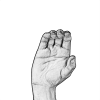
One of the more common versions is to fingerspell it.CAR
I recommend you just spell this concept. Seriously. It only takes three letters
Note: The fingerspelling of the word car becomes somewhat lexicalized (sign like). For example, when you fingerspell "C-A-R" at high speed you may notice that your thumb on the tends to "hang out" when you get to the letter "R" (instead of wrapping around).
CAR:
Of course you will also see the classic "steering wheel" version of the sign for car.
Use a small quick movement that looks as if you were turning a small steering wheel side to side.

DRIVE-to:
The sign DRIVE can be modified to mean "drive to here."
DRIVE-to-here:
DRIVING: (Version)
When telling a story about someone driving you can use a large movement and corresponding facial expressions to show how you would look if you were actually manipulating a steering wheel.
Yes, yes, I know -- I look like a bum in these pics. These are the pics that inspired me to start shaving my head bald and wearing a black dress shirt for future pictures.
There are many ways to express the concept of "driving." To sign "DRIVE-TO" you'd just use a single forward movement. To sign "I was driving along" the hands move forward, back, and forward a second time (using a couple of short quick movements). If it was a "long drive" then you can modify the sign by using a larger forward movement.
DRIVING (version) "cruising" / "I was driving along..."
Signed English version:
You might see "car" signed with two "C" hands, hitting one on top of the other (the pinky of the top "C" hits against the index finger of the bottom "C"). That version is quite common in the Deaf Community but I don't recommend you do it on an ASL test.
Also see: CAR/DRIVE
Also see: DRIVE
Also see: TRUCK
Also see: LIMOUSINE
NOTES:
In a message dated 10/29/____ 3:26:29 PM Pacific Standard Time, ___________@hotmail.com writes:
Hello Dr. Bill,
I am a 13 year old who wants to learn ASL and your website has helped me tremendously. I also had a question on signing "drive" when your hands are in "C" handshapes doesn't that mean "car" and when you have your hands in "D" handshapes doesn't that mean "drive"? Or have I gotten mixed up with something else.
Thanx :)
- Chickie
Dear Chickie,
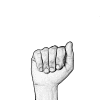
What you are talking about is called "initialization." Initialization is the practice of using the initial letter of the English translation of a sign as the the handshape for that sign. While it is true that quite a few signs are "initialized," initialization is not something that applies to the majority of signs in ASL. It is also true that most Deaf people are bilingual (know two languages). Here in America, most "culturally Deaf" people know both ASL and English. Quite often that knowledge of English influences a Deaf person's use of ASL. But whether or not an influence from English becomes an accepted part of ASL depends on how many users adopt the innovation (the new sign or method of signing). So, back to your question about the signs for drive and car: "Drive" is a verb and is signed larger and or in a more "mime-like" fashion than "car." CAR is signed smaller, quicker and in a less iconic way (that means it doesn't look so much like you are holding the wheel of an actual car). Both signs use "S" hands.
If your local sign language instructor has taught you to sign "DRIVE" using "D" hands, just file that away in the back of your mind that you have "one vote" for an initialized version of "DRIVE." Then, as you get out in the Deaf world and interact with skilled, native users of ASL you will start getting many, many votes for the non-initialized version (using "S" handshapes). In any case, set a goal to always be polite and open minded about such discussions (and it seems you are indeed a such a person) since language changes over time and from region to region. My strong recommendation however is to stick with the "S" hand version.
Dr. Bill









Want to help support
ASL University? It's easy:
DONATE (Thanks!)
(You don't need a PayPal account. Just look for the credit card
logos and click continue.)
Another way to help is to buy something from the ASLU "Bookstore."
Want even more ASL resources? Visit the "ASL Training Center!" (Subscription
Extension of ASLU)
CHECK IT OUT >
Bandwidth slow? Check out "ASLUniversity.com" (a
free mirror of
Lifeprint.com less traffic, fast access)
VISIT >
You can learn
sign language
(ASL) online at American Sign Language University ™
Lifeprint.com © Dr. William Vicars