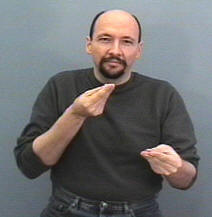
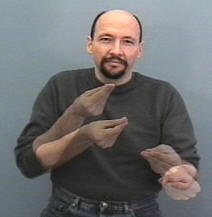
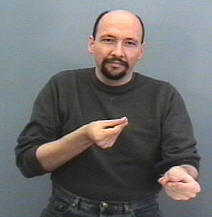
The sign for "breastfeed" or "breastfeeding" is to do the sign "nourish" but originate it from near the breast. This sign is best done after introducing the concept of "breast" and "nourish" as separate signs and then for the remainder of the conversation you can use the location-specific more efficent version of breast-feed. In more casual conversations amongst intimates or close female friends the milk sign done horizontally with the pinkie-side toward the breast is very commonly recognized, but is not a sign done "in public" and especially not around non-signing "Hearing people."
BREAST:
NOURISH / feed-to:
(The sign "nourish" uses a double movement.)
BREASTFEED: (1st usage during a conversation)
This version uses a combination of "BREASTS"-(regular movement) + "NOURISH/feed"-(single movement)
When you combine the signs BREAST and NOURISH into "breast-feed" you are creating a compound sign, and thus will drop the double movement of the sign NOURISH and instead use a single movement.
BREASTFEED: (2nd and continued usage during a conversation)
This version uses a combination of [The location of "BREAST"] + NOURISH-(double movement)
When you combine the signs BREAST and NOURISH into "breast-feed" you are creating a compound sign, and thus will drop the double movement of the sign NOURISH and instead use a single movement.
BREASTFEED: (casual / intimate version - used among close friends)
This sign modifies the sign for "MILK" and does it with the pinkie side of the hand hand an inch or so in front of (but not touching) the breast and the thumb side pointing forward. (As if squeezing milk out). This version of the sign "breastfeed" is not usually used in general public.
SUCKING-on-breast:
This version means "suck on breast." It can be used to mean breastfeeding.
Pull the hand forward away from the breast as you change the hand to a flattened "O" shape.
Optional Reading / Discussion:
In a message dated 12/18/2007 9:02:04 A.M. Pacific Standard Time, lora@ _______ writes:Dear Dr. Vicars,
I am a mother of two. I taught several basic signs to my older child with the aid of your website. Currently we are signing to our youngest son who is 8 months old. Both our children, my husband, and I are hearing.
I read the several options for BREASTFEEDING. Currently we sign MOMMY and MILK. It would be so much faster to combine the signs and sign MILK while my thumb is on my chin for the sign MOMMY. Basically it would be thumb on chin, and squeezing the remaining fingers.
I don't want to inadvertently sign something inappropriate, or accidentally be using the sign for something else. Would this be an appropriate contraction of two signs that my son could use when he wants to nurse?
Many thanks,
L.R. (name on file)Dear L.R.,
First of all, the sign you describe is not an existing ASL sign so there is no danger of it duplicating an offensive sign. The combined movement, location, and shape of the of the sign are not offensive. While I wouldn't go so far as to promote such a sign for widespread use by others, It could be used as a form of shared communication specifically between a mother and her child. It wouldn't be "ASL." It would be a "home-sign" that held meaning for people in and associated with your home. Mothers all over the world often come up with special words for use with their children while communicating via spoken language. They sometimes develop special words so that they can communicate in public about rather private or "socially awkward" topics. The same principle certainly extends to use of signed languages. Most of such words never make it to widespread use, but who knows, 20 years from now your son and his future wife might use the same sign with their newborn (your future grandchild).
Cordially,
Dr. V
(Note to self: Neologism / Protologism)
Notes:
Recently I received an email from someone developing a "babysigning" type of website. This person asked me:
"Is there no true sign for Breastfeeding/Nursing the way there is for Bottle? What is the most common sign mothers use? Why is there no universal sign for Breastfeeding?"
Ah yes, that is the danger and the problem with Hearing people (who have little or no ongoing interaction with the Deaf community) designing and developing "sign language sites." Such individuals don't know the cultural rules and norms because they don't live here (in the Deaf Community). Some Hearing people email me (one of the few Deaf or HH persons they can find) instead of asking their local "Deaf friends" because they (the Hearing persons) have few or no local Deaf friends to ask. My suggestion? Put in the time (years) and effort (tons of it) to become culturally aware and linguistically fluent prior to trying to use our (Deaf) language (ASL) to make money.
--Dr. Bill
p.s. To her credit, after I told this person the above information she emailed me back and was grateful for the feedback. I then thanked her for having a good attitude.




Notes: