Hello ASL Heroes!
Great to meet you!
I'm president and owner of the Lifeprint Institute, a consultation business focusing on technology-enhanced delivery of ASL Instruction, excursion-based instruction (trips to amusement parks), occasional "hyper-immersions" (intense one-week, semi-private, residency-based immersions), and occasional "ASL Linguistics" and/or "Train the ASL Trainer" workshops.
For many years I was a full-time, tenured, (full) Professor of American Sign Language and Deaf Studies at California State University, Sacramento (a.k.a. "Sac State").
I am Deaf. (I was born hard of hearing and have become progressively more Deaf over the years.) I married a Deaf woman, work in the field of Deaf-Studies, hang out people who can sign, watch only movies that have captions, have a daughter who attended the Utah School for the Deaf preschool program, attend only Deaf churches, use an interpreter for work meetings, have a text-only phone, and devote my time to developing ASL-related resources for students, teachers, interpreters, and parents of Deaf children.
Forgive this next bit of information (I share it because some people want to know their instructor's qualifications).
Some of my degrees and certifications (past and/or present) include:
A doctorate in Deaf Studies & Deaf Education from Lamar University (accredited), a masters in Deaf Education (accredited), MCSE (Microsoft Certified Systems Engineer), MCT (Microsoft Certified Trainer), A+ (COMPTia Computer Technician), N+ (Network Technician), ASLTA certification (American Sign Language Teachers Association), and "EdNet" (Distance Education Certificate). Most of which have probably expired (except the degrees, last I checked they don't have an expiration date).
Some of my current and/or past experiences and qualifications include:
- Decades of experience as a university-level ASL instructor including workshops presented internationally
- Authored and self-published "Sign Me Up!" (Which was a really cool 212-page ASL Guide and activity book that sold out all 3,000 copies. Eventually I turned it into the Lifeprint website.)
- Directed an 18-month Interpreter Training program (twice)
- Co-chaired the Disability Law Center's Consumer Advisory Council (UT)
- Served a term as an elected board member of the Utah Association for the Deaf
- Parent of a child who attended the Utah State School for the Deaf pre-school program
- Set up and directed a not-for-profit a 501(c)(3) organization to improve Deaf access to services (the precursor to ASL University)
- Served as advisor to the Sign Language Association (ASL Club) at Weber State University (an award winning organization)
- As far as I know, I was the first ASL instructor from Utah to earn certification from the American Sign Language Teachers Association. A bit of nostalgia for you -- way back when I first joined ASLTA they called themselves S.I.G.N. (Sign Instructors Guidance Network).
Yadda, yadda, yadda... and a bunch of other fun stuff.
For around two decades I taught in the ASL and Deaf Studies Program at California State University, Sacramento. In addition to the basics I taught a variety of Deaf Studies courses and topics including ASL linguistics, Classifiers (depictive signing), and special topics like "Medical Signing," "Technology Signs," etc. I served quite a few years as the "Program Coordinator." Don't let the "coordinator" title impress you. It is just code for "work more with no extra pay."
For many years I've enjoyed being married to a wonderful woman named "Bee."
My wife, Bee, also teaches ASL.
(She's probably a better ASL teacher than I am -- but at least I tell better jokes.)
[Update: She's gotten funnier over the years and now tells better jokes too. Dang.]
She was born deaf as a result of the rubella epidemic of ____. (I deleted the year for safety reasons. My safety. She might kill me while I sleep if I go around telling people her age.) She attended a day-program for the Deaf in Bakersfield, California. She learned ASL prior to learning how to talk. She has taught college ASL classes and numerous community education ASL courses for many years. She's a wonderful mom, and is rumored to be a great cook. Once in a while I let her beat me in Scrabble. (It is good for her self-esteem.)
We share a home in Sacramento, California with several small furry creatures. (That's pets. Our pets are furry, not our kids).
We have four terrific orangutans, er, kids.
[Update: They all grew up and moved out.]
[Update: They all take turns moving back in.]
[Update: The kids move out, move back, and move out again -- depending on how their lives, relationships, and employment are progressing.]
People ask me if my children are Deaf.I tell them my kids are "hard of listening". [That isn't a technical term folks.]
The older three kids have normal hearing when it is time to eat and seem to be somewhat hard of hearing when it is time to take out the garbage.
(Just kidding. Actually we sign around here and they are very helpful when asked to help out.)
The youngest, Sarah, is Deaf (hh). She also has Apert Syndrome. She is a bundle of joy and energy. (She's a brave, spunky kid I'll tell you.) She attended the Utah State School for the Deaf pre-school day-program.
[Update: Somehow she grew up and currently she alternates between working, attending college, and creating art.]
[Update: She is attending Utah Valley University which has been doing a wonderful job of providing an ASL interpreter for her classes. Yay UVU! Seems to be an excellent choice for Deaf students.]
Warm regards and best wishes,
- William G. Vicars, EdD.
Director, ASL University
p.s.
* Naming conventions:
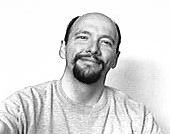
I'm not overly concerned about what you call me but if you haven't figured out by the name, the bald head, and the (attempt at a) beard -- I'm a "he" (him, guy, dude, fellow, etc.)
I'm also not going to be offended if anyone calls me "Bill."
Subscribers and other people who follow me online tend to call me by my stage name: "Dr. Bill"
My in-person and/or college students tend to call me "professor," "Dr. Vicars," or "Dr. V"
If you are both a blood relative AND older than me you may call me "Billy."
What my wife calls me depends on whether I've told anyone her age recently and/or other factors.

For your amusement, (because you seem to be a curious sort of
person who likes amusement seeing as you have read this far) below
is an archived resume / vita from around the middle of my time at
Sac State with some updates but certainly not current. If you
are headhunting me to offer me an embarrassingly-high-paying
position doing interesting work with fun colleagues -- feel free to
ask for an updated resume / vita.
WILLIAM G. VICARS, EdD
Full-time Tenured Professor of American Sign Language and Deaf Studies
California State University - Sacramento,
6000 J Street, Sacramento, CA 95819-6079
Preferred contact: BillVicars@aol.com
EDUCATION
Ed.D., Deaf Education / Deaf Studies, Lamar University, Beaumont TX,
(2003)
M.S., Deaf Studies/Deaf Education, Lamar University, Beaumont TX,
(2000)
B.A., Communication / Public Relations, Weber State University,
Ogden, UT (1991)
EXPERIENCE:
California State University -- Sacramento
American Sign Language and Deaf Studies Program (2003 - 2020)
Taught Deaf Studies and American Sign Language courses. Served twice
as program coordinator. Coordinated
course offerings and teaching schedules.
College of Continuing Education, California
State University -- Sacramento
ASL Online and Immersion Programs
Instructor / Faculty Director of ASL Course Offerings, (2004 — 2020, part-time)
Taught Deaf Studies and American Sign Language courses. Coordinated
course offerings and teaching schedules.
Sierra College, Department of Deaf Studies,
Rocklin, California
Adjunct Instructor, (2009 — off and on for several semesters as
needed)
Taught Deaf Studies and American Sign Language courses.
Lifeprint Institute (www.Lifeprint.com)
American Sign Language Distance Education Training
Director / Webmaster / Curriculum Developer / Lexicographer (1989 —
present)
Designed, created, and maintained an online ASL resource center for
interpreters, students, and parents of deaf children.
Lamar University, Department of Communication
Disorders and Deaf Education
Adjunct Instructor / Graduate Assistant (2000 — 2003)
Taught Deaf Studies and American Sign Language courses as a graduate
assistant for the academic department and as an adjunct for
Department of Continuing Education.
Weber State University
Department of Communication
Adjunct Instructor (1988 — 1998)
Taught American Sign Language courses.
ADDITIONAL EXPERIENCE (Contract projects and freelance work)
Davis county School District, Utah
Director, Interpreter Training Program (1995—1997, part-time)
Set up and directed an in-service accelerated Interpreter Training
Program.
Weber County School District, Utah
Community Education Instructor, American Sign Language, (1992—1997,
part-time)
Taught Deaf Studies and American Sign Language courses.
Davis County School District, Utah
Community Education Instructor, American Sign Language (1992—1997,
part-time)
Taught Deaf Studies and American Sign Language courses.
Church Education System, Ogden UT
Instructor, (1991-1992, part-time)
Taught seminary courses to Deaf youth.
RESEARCH AND CREATIVE ACTIVITY:
[Significant / ongoing / current activity information available
on request.]
Vicars, W. (2007), Sign Language Field Manual: Fingerseek.
Lulu Press [ISBN 0-9749543-1-4]
Vicars, W. (2007), ABC Slider. Lifeprint Press: http://asl.gs
Vicars, W. (2006), ASL Number Practice Tool. Lifeprint Press http://www.asl.bz
Vicars, W. (2005), Fingerspelling Practice Tool. Lifeprint Press http://www.asl.ms
Vicars, W. (2003-2007), ASLpah! Ezine and Forum. Lifeprint Press <http://aslpah.com> [Monthly circulation: 10,000 opt-in subscribers.]
Vicars, W. (1998), Sign Me Up! Lifeprint Press [Print run: 3,000 copies, sold out] [ISBN: 0-9749543-0-6) 212 pages. Out of print.]
Vicars, W. (1997-2012), ASL University, Lifeprint http://www.Lifeprint.com
Online American Sign Language lesson materials and coursework hosted at www.Lifeprint.com
- Average number of unique visitors per month: 200,894
- Average Number of Visits: 353278
- Number of files: 38,368 files
- Number of Hyperlinks: 257,490
- Consistently ranked high in results for numerous Google search terms including: "ASL," "American Sign Language," and "Sign Language."
PUBLICATIONS IN WHICH WILLIAM G. VICARS' IMAGES OR ARTWORK APPEAR (partial list)
* Language files: materials for an introduction to language and linguistics, 11th Edition, Christin Wilson, co-editor, Ohio State University Press. (2010)
* SMART Interactive Whiteboard and Interactive Table Technologies ASL Project, Tim West, Waterford Research Institute, (2010)
* Language files: materials for an introduction to language and linguistics, 10th Edition, Anouschka Bergmann, Kathleen Currie Hall, Sharon Miriam Ross, co-editors, Ohio State University Press. (2007)
* ASL Curriculum for 2nd and 3rd Graders, Online Publication, Unitarian Universalist Association, Massachusetts. (2007)
* What learning a second language might teaching us about auditory training. Barcroft, J. Sommers, M.S. & Tye-Murray, Seminars in Hearing, 28, 151-161 (2007)
* Introduction to Psychology, www.ablongman.com/irc, & www.mypsychlab.com Lilienfeld, Lynn, Namy, and Woolf.. Allyn & Bacon (2007)
* Abilities: The style magazine for Canadians with disabilities. Jaclyn Law, Managing Editor. (2006)
* ASL Makes a Splash, Cadence Magazine, Volume 34, Lamar University, (2006)
* History of ASL, Carol Breezes (2006)
* Pointing and spatial layout in adult home sign systems in Nicaragua. Coppola, M., PhD Proceedings of the Boston University Conference on Language Development, 29, 144-155. Boston: Cascadilla Press. (2005)
* Flash Card Program -- Manual Alphabet, William C. Camp, Programmer, Texas Instruments, Missouri(2006)
* Linguistic Anthropology: A One day Introduction to Sign Language and Deaf Culture. http://linganth.blogspot.com/2006/12/lesson-suggestions-for-introduction-to.html & http://disstud.blogspot.com/2006/11/introduction-to-sign-languages-and.html (2006)
* Jamaican Introductory Sign Language and Training Handbook. Gregory Bryan, Georgia Caribbean American Heritage Coalition, Jamaica (2006)
* Barbara L. Hocking, M.A. (2010). Workshop: Signs of Nature, "The 2010 Conference of the American Horticultural Therapy Association" Glencoe, Illinois
* Tessa Smith, (2010). Disability Employment Awareness Month (web page), Diversity Events Committee, Internal Communications & Diversity, Dallas Fort Worth International Airport
* Mary Sterritt, (2010). Daylight Project: Front staff training program, Powerpoint presentation, Mental Health Center of Denver
* P. Powell Dobbins PhD, (2008). Artist Installations with Performances, The Opening of the Art Exhibit, New Mexico
* Kris Mandley, (2007). Lexical Borrowing: Loan Signs and Fingerspelling (Interpreting Workshop), Schaumburg School District 54, Illinois
* Beth Orton Carlson, PhD, ASLTA. (2007). Linguistics of ASL, presentation, St. Petersburg College, Florida
* Jolayne Tweedie. (2007). Approaches to Teaching Deaf Children in Malaysia, Johor Area Rehabilitation Organization, Malyasia
* Eddy F. Laird PhD. (2007). ASL Semantics: Types of Meaning, (McDaniel University), at ASL Fest - Gallaudet University's Center for ASL Literacy
* P. Powell Dobbins, PhD. (2007). Artist Installations with Performances, Historical Conference, Texas
* National Science Foundation Program. (2007). Web-based Teaching of Sign Language, Historically Black College or Universities Undergraduate Summer Research Program
* Aurora BayCare Medical Center. (2006). Basic ASL Signs for Health Care Professionals, Wisconsin
GRANTS AND AWARDS
2010 Sabbatical Leave Award, ASL Fluency and Deaf Literacy
Project.
2009: Research and Creative Activities Award: "Deaflympics" Taipei,
Taiwan: Study of lexical gaps in ASL
2008: Professional Development Grant: "Train the ASL Trainer" Guyana, South America: Train Deaf Education Instructors
2008: ELIXR Grant: Universal Design, (http://pachyderm.cdl.edu/elixr-stories/udl-sign-language/) Model best practices
2006: Pedagogy Enhancement Award, Development of an Online American Sign Language Number Practice Tool
2006: Teaching Using Technology Award (2nd year) Development of basic ASL letter learning tool
2005: Teaching Using Technology Award: Development of an Online American Sign Language Fingerspelling Practice Tool
2004: International/Global Education Faculty Development Grant: Linguistics of ASL Online Course for ASL teachers and Interpreters
PRESENTATIONS
* ASL Wahoo! Engaging Students via Technology, Cal Ed Conference, Sacramento (2010)
* Teaching ASL Online, Sierra College, California (2010)
* Train the ASL Trainer, Clear Creek Independent School District, Texas (2010)
* ASL Pragmatics, Houston Community College, Texas (2010)
* ASL Safari Train the Sign Language Trainer Series, Guyana, South America (2008)
* Universal Design: ELIXR, Directors of Educational Technology - California Higher Education Conference (2008)
* Train the ASL Trainer: Methodology of Distance Education, California State University, Sacramento (2008)
* Deaf Awareness Week: American Sign Language, California Department of Education (2007)
* Interpreter Training Series, Carson City School District, Nevada (2007)
* ASL Safari: Immersion Camp for Certifying Interpreters, Grover Hot Springs, Sierra Nevada Mountains, California (2007)
* How to Put your PowerPoints on a Diet, California State University, Sacramento (2007)
* ASL Training Series for Employees who Work and Interact with the California Schools for the Deaf, California Department of Education (2007)
* Interpreter Training Series, Carson City School District, Nevada (2006)
* Extreme Roll Shift: An American Sign Language mini-workshop on Dramatic Characterization Techniques, California State University, Sacramento (2006)
* American Sign Language and Computer Assisted Language Learning, College of Continuing Education, China Programs & Jinan, China Delegation California State University, Sacramento (2006)
* ASL Safari: Immersion Camp for Certifying Interpreters, Grover Hot Springs, Sierra Nevada Mountains, California (2006)
* Train the ASL Trainer, North West ASLTA, Washington (2005)
* The Linguistics of American Sign Language, World Language Day Conference, California State University, Sacramento (2004)
* ASL Pragmatics, College of Continuing Education, California State University, Sacramento (2003)
* Training Series: ASL for Employees with Work and Interact with Deaf Employees, Morton International, Utah (1993)
* Disability Awareness and ADA, Department of Management Services, Ogden City, Utah (1993)
* Interacting with Deaf Youth, Office of Youth Ministry, Utah (1993)
* Training Series: ASL for Employees with Work and Interact with Deaf Employees, United States Department of Agriculture, Utah (1993)
* Deaf Studies Training Series, Utah Interpreter Services, Utah Division of Services for the Deaf and Hard of Hearing (1992)
* American Sign Language Training Series: Communicating with Deaf Patients, McKay Dee Hospital Center, Utah (1992)
* Diversity Awareness, Multiple Sclerosis Society (1992)
* Diversity Awareness, Federal Aviation Administration, Utah (1992)
* Training Series: ASL for Employees who Work and Interact with Deaf Employees, Internal Revenue Service, Department of Treasure, Utah (1991)
CONTINUED PROFESSIONAL DEVELOPMENT
* Using Technology to Enhance Education Services for Students who are Deaf or HoH Midwest Center for Postsecondary Outreach, St. Paul Technical College, Minnesota (2002)
* Microsoft Certified Systems Engineer Training Program: MCSE, A+, N+, and MCP+I, IKON Office Solutions / Microsoft Corporation (1998)
* Introduction to Network and Internet Lab Management, Utah LINK Training for Distance Education, University of Utah (1998)
* EDNET Copyright, Utah Education Network, Utah State Office of Education (1998)
* ASL Numbers and Fingerspelling, Utah Interpreter Services, Salt Lake Community College (1998)
* ASL Register and Nonmanual Markers, Utah Interpreter Services, Salt Lake Community College (1998)
* Methods of Teaching ASL, Salt Lake Community College, Utah (1998)
* Training Series: Partners in Policy Making, Utah Governor's Council for People with Disabilities (1997)
* Introduction to the Protection and Advocacy for Individuals with Mental Illness, Legal Center for People with Disabilities (1996)
* Semantics of ASL, Utah Community Center for the Deaf, Utah State Division of Services for the Adult Deaf and Hard of Hearing (1995)
* Course Series: Human Services, Pacific Western University (1993—1994)
* Advanced Employment Specialist and Vocational Training, Technical Assistance and Continuing Education, Univ. of Northern Colorado (1992—1993)
* American Judicial System/Deaf Community Liaison Training program, California State University, Northridge (1993)
* Writing the Grant Proposal, The Grantsmanship Center, Utah (1993)
* Assistive Technology for Vocational Training Programs, Easter Seals Society of Utah, Salt Lake Community College (1993)
* Trends in Vocational Training, Southern Utah University (1993)
* The Deaf Mentor Model Project, The Ski Hi Institute, Utah State University (1993)
* Legal Interpreting Workshop, Utah Interpreter Services, tah Community Center for the Deaf (1992)
* Organizational Behavior, Army Institute for Professional Development, Utah (1989—1990)
* Training Series: Investment in Excellence, The Pacific Institute, Washington & Department of Defense, Utah (1989)
SERVICE
National and International
2008-present Guyana, South America: Deaf in Guyana (DIG) Committee advisor / consultant.
2010-2010 Federal Bureau of Investigation, Liad Akronowitz, ASL Training Project, consultant
2006 Israel Center for the Deaf, Israel, Curriculum Development and Instruction for Deaf Israelis, consultant
2006 Georgia Caribbean American Heritage Coalition, Jamaica, "Jamaican Introductory Sign Language and Training programme," consultant
State & Local
2010 Folsom/Cordova Unified School District Special Needs Resource Development Program / David Schetter's Deaf & Hard of Hearing Resource Group, member
2010 Deaf Coalition: "Anti AB2072" Participated in efforts to defeat this legislation. Visited legislator's offices, attended the senate committee hearing at State Capitol, engaged in video phone campaign, participated in opposition rallies, etc.
2009 "California Department of Education Deaf Awareness Week,"
State Office of Education, lobby display: Deaf Studies,
guest representative
2006-2006 California Commission on Teacher Credentialing, California
Subject Examination for Teachers, CSET:ASL, Scoring Level and
Evaluations Development Subcommittee, member
2005-2005 California Commission on Teacher Credentialing,
California Subject Examination for Teachers, CSET:ASL, Bias
Subcommittee, member
University
2007 CSUS University-wide "Preview Day," faculty representative
2007 Instructional Materials Accessibility Subcommittee, member
2006-2007 ADA Technology Consultant, Equal Opportunity/Affirmative Action
College
2008-present Affirmative Action Representative (F 08-Sp 11)
2008-present Dean's Advisory Council, alternate (F 08 - Sp 11)
2007 Search Committee, College Director of Information Technology,
member
2007 Outside reader/advisor for CSUS College of Education masters degree candidate Chandra Ashton,
2006-2007 Dean's Advisory Council, member
2006-2008 Technology Advisory Committee, alternate (F 08-Sp 10)
2006-2008 Technology Advisory Committee, chair
2004-2005 Technology Advisory Committee, co-chair
2004-2010 Established and directed Online ASL Program, College of Continuing Education
2004-2010 Established and directed Summer ASL Immersion Program: College of Continuing Education
Department
2007 Deaf Studies Search Committee, chair
2005 Deaf Studies Search Committee, member
2005 Field Trip: Set up and directed student ASL immersion (Knottsberry Farm)
2004 Field Trip: Set up and directed student ASL immersion (Marine World)
2004-2005 ASL Certificate Program Advisory Committee
2003-2005 Established and advised the student group: "The Sign Language Association"
2004-Present Student Advising
2003 Field Trip: Set up and directed student ASL immersion (Disneyland)
Community
2010 Car Donation Project, facilitated the donation of a car to a low income Deaf family
2010 Hacienda La Puente Adult School, California, Curriculum Web Development and Consultation
2010 Funeral of local Deaf Community member, conducted religious service
2007 SIGNews, Kelly Sargent, staff writer, Communication Service for the Deaf, Inc (CSD), Interviewee
2007 Dr. Jean Andrews, Lamar University, Field Research Collaboration
2007 Two Little Hands Productions, PBS, Signing Times, American Sign Language panel expert
2006 New York City ASL Meet Up Group, curriculum consultant
2006 LK Moss Primary School, Georgia, nonverbal hearing children, advisor
2006 Sacramento County Office of Education, Prevention and Student Services, ASL and Deaf related services, consultant
2006 Florida State University Emergency Response Project, Designed prototype signage and descriptive images
2006 Office of Assemblyman John J. Benoit, Assembly Bill 49; consultation regarding interpreting
2006 Austin Community College ASL and Interpreting Program, consultation regarding Linguistic Query: Iconic versus Onomatopoeia
2005 Sacramento County Department of Health and Human Services employee ASL Skills Evaluation
2004 Lamar University, Dept of Communication Disorders and Deaf Education, Leadership Training in Deaf Education, Advisory Committee, member
2004 NuTV -- Channel 95, Utah, "Disability Awareness and Sensitivity Issues" advisor
Notes: