Initialization (in American Sign Language) is the process of using the ASL fingerspelled letter that
represents the first letter of an English word as the handshape for a sign.
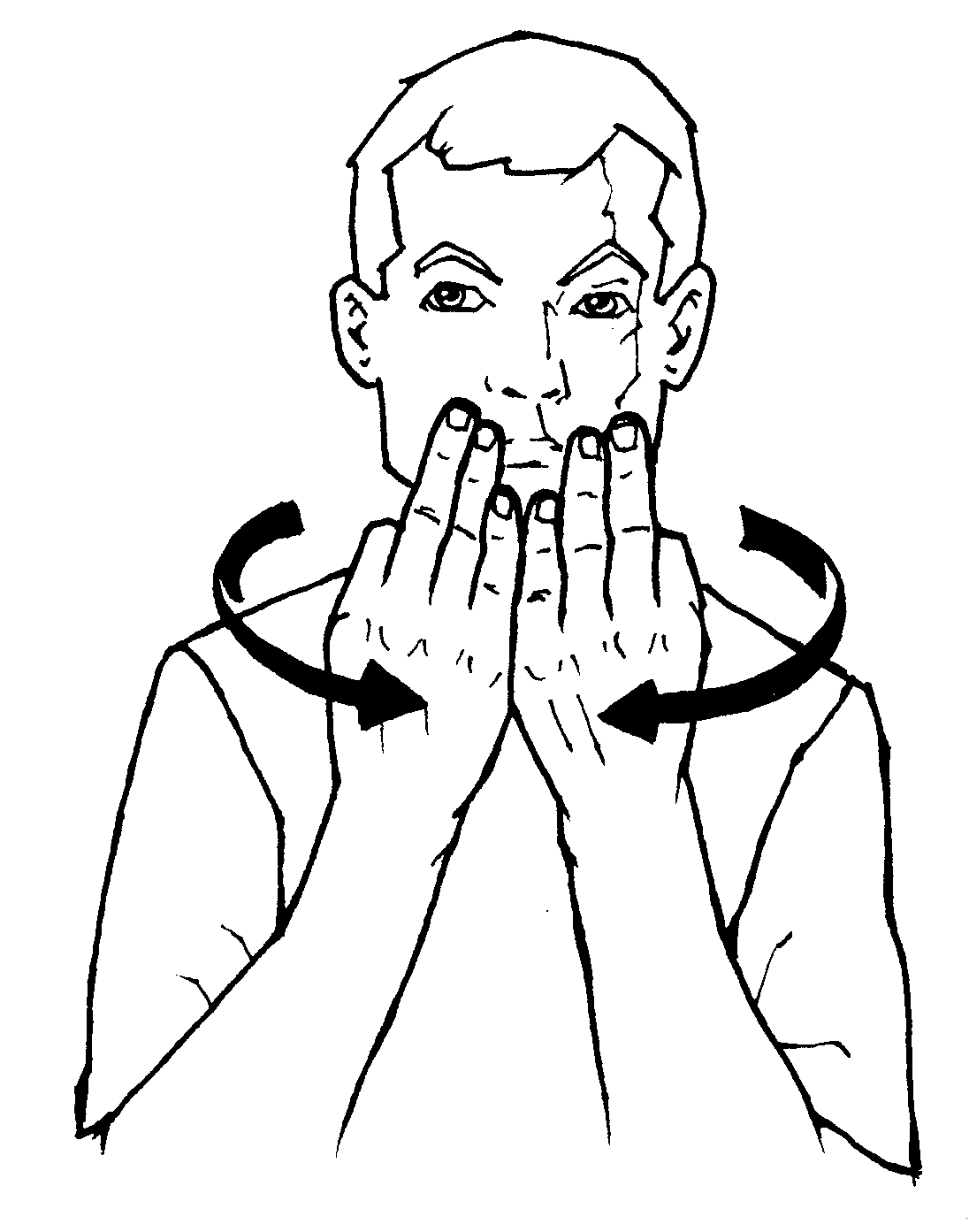
For example, the signs CLASS and FAMILY are initialized signs.
FAMILY:
Warning: Overuse of initialization is frowned upon by the Deaf
Community. While it is true that quite a few initialized signs have found
their way into general usage in the Deaf community--you would do well to be
careful in your use of initialization if you are trying to develop your ASL
skills.
Initialization (using the first letter of the English word for a
sign as the handshape for the sign) has become associated with
"Signed English" in the minds of some (many) ASL teachers and
other signers. Some of these individual eschew (deliberately avoid using)
initialization. That means they go out of their way to NOT use
"letters" as the handshapes for their signing. Yet other
people feel that such individuals are overdoing it.
Students are often confused as to when it is okay and when it is not okay to initialize a sign.
It may help to think more in terms of "unnecessary" English linkage as being the issue.
Marking up your signing with more complex handshapes when simpler shapes will do -- adds unnecessary work and is therefore disliked by those who do a lot of signing.
Doing the sign RED with an "R" hand instead of an index finger doesn't add appreciably to the communication effectiveness of the sign since there are no conflicting homonyms. In other words the sign "RED" isn't competing with any other signs
using that movement, orientation, and location -- except the sign PINK. Since RED is the more common concept it gets the "unmarked" handshape (of a "plain" index finger) and PINK get marked up with a "P" handshape.
NURSE with a modified-N hand is efficacious (good) because otherwise the sign would be ambiguous and easily confused with "doctor."
The reason why this is a hard concept for Hearing people is that to know when it is good and when it is not good to use an initialized sign you have to know the spectrum of existing signs.
Beginners can't make good decisions or choices related to when and when not to initialize a sign because beginners do not know which signs have competition (for the same location, orientation, and movement) and which signs don't.
That is why you are following the right path:
Find a decent sign that you see being used by lots of Deaf people and stick with that sign until you have compelling evidence otherwise.
Now just repeat that process 10,000 times.
Simple.
[There is no shortcut.]
In a message dated 1/20/2014 8:29:28 A.M. Pacific Standard Time, cartwright2012
writes:
Hi Bill -
...
I am working on a project about initialized signs and I will give a presentation
on this issue at Deaf Studies Today! Conference. My title would be Initialized
Signs: Analysis of Community Acceptance and Rejection.
Curious .... The list of initialized signs on your website.... How do you
determine those initialized signs to be acceptable and are being listed? How do
you determine that some other initialized signs seem "unacceptable" and you may
not want to include them on the list?
I am aware that most of times people usually explain that "these look or feel
right" and "those do not look or do not feel right". Mostly based on the gut
feeling. That is Ok. I wonder if you have any reasons for listing those specific
initialized signs you chose for the website.
...
Daisy
Daisy,
Here are some reasons for you:
1. Historical Prevalence: If a sign has a long history of initialization
(several generations of usage) and has long been accepted as an ASL sign it will
be resistant to change -- or rather the people who use the sign will be
resistant to changing their version. For example: FAMILY. There are those
who push to replace the initialized sign FAMILY with an uninitialized
(international) version. However there are many Deaf (as of this writing)
that resist and don't like the de-initialization of the sign FAMILY because that
is the sign they have always used. For many it is the sign their parents
and grandparents used. it has existed for several generations. There are
initialized signs that have "always" (as far as we can tell from historical
review) been initialized.
2. Lack of existing/alternate ASL form. If a concept has no existing or
alternate non-initialized sign an initialized sign is more likely to be accepted
as an ASL sign. For example "AUNT." There is no non-initialized specific sign
that means "aunt" in ASL. The sign "AUNT" is well accepted in ASL. An example of
a sign that is increasingly "not" accepted in ASL due to having a
non-initialized competing ASL version is the initialized sign for SINGLE.
Instead people can sign SINGLE using a "1" handshape (at the corners of the
mouth) or use the version of SINGLE that means "alone / someone / something."
Thus "SINGLE" has not one but two competing ASL non-initialized versions. The
initialized signs YELLOW and BLUE do not have common ASL non-initialized
versions and thus are well accepted. There is a very common non-initialized sign
for RED and so the initialized sign for RED is not acceptable.
3. High utility and economy of movement: If a concept is used frequently and the
initialized version of the sign for that concept is able to be produced using
less effort than the non-initialized version of the sign then it is likely that
the initialized sign will eventually gain acceptance as an ASL sign. For
example, the initialized signs for BREAKFAST / LUNCH / DINNER are very common in
the Deaf world. Part of the reason for this is that doing a one-handed
initialized version of "BREAKFAST" is easier and generally faster than doing the
two-handed compound sign "EAT-MORNING."
4. Zeitgeist and Social Currency: Sometimes a sign or a version of a sign
becomes popular simply because it is marketed and used by leaders or
celebrities. For example, the non-initialized version of SYSTEM that is done
with a "Y" hand is neither more utilitarian nor more economical than the
initialized sign for SYSTEM. However, using the "Y" hand provides a form of
self-branding and a way to declare one's membership in the "in" group. The
sign for "language" for many years (decades actually) was initialized and became
a regularly accepted as the typical sign for "language." Then people
started advocating doing the LANGUAGE sign with "F" hands (even though it makes
the sign less clear for bilingual ASL/English users) as a way of remaining
connected to the historical roots of this sign.
5. Political Correctness / Language Borrowing: If a concept is strongly
associated with another culture and the sign language associated with that
culture uses a competing non-initialized sign there is a likelihood of that sign
being adopted into the lexicon of ASL and replacing the former ASL sign. For
example: JAPAN. Consdier which adoption rate is higher: the "new" (borrowed)
sign for JAPAN or the "new" (borrowed) sign for CHINA? The former common ASL
sign for CHINA was done as a non-initialized sign with an "INDEX"-finger
twisting near the corner of the eye. The former common ASL sign for JAPAN
was done as an initialized sign by doing a "J" near the corner of the eye.
Loose interviewing at the time seems to indicate that people were slightly
slower to adopt the new sign for CHINA than the new sign for JAPAN. (Some of
this may be the proximity of the older sign for CHINA and the location of the
sign for FOOD and the fact that "Chinese food" is somewhat more common (in
America) than "Japanese food." Regardless, it seems initialized-ASL signs are
more vulnerable to replacement via language borrowing than non-initialized
signs.
Good luck.
-- Dr. Bill
[The above response was updated somewhat in 2021]
-----------------------------------
Future development:
6. Phonesthesia Differentiation
7. Mouth Morpheme Linkage
8. Iconicity Preference (WHALE)
9. Same sentence (or discourse) homonym distinctions
10. Semantic range (second usage) distinction
11. Stigmatization avoidance
The following discussion was held over a decade ago (mid-to-late-aughts of the
2000's).
It is regarding the initialized version of the initialized sign for SINGLE. A
teacher of the Deaf noticed an initialized sign for "single" in one of the
quizzes at Lifeprint.com.
She emailed the following:
<<OH...."single"...with an "s" and not the first finger on each side of the
mouth. I see....that was a very English-type sign. I'm surprised you signed it
that way. Hmm. Interesting. Is that how everyone is signing it now in ASL?
Should I change that? I don't want to be left out of the loop. :)
Smile!! I showed my kids your signs and they thought it was so neat to be able
to pull that up on the web. They also thought it was neat that I knew you. My
kids are 6-8th grade and vary in ability levels from 1st-5th grade in reading
levels. They all enjoy being able to see adult signers. I enjoyed being able to
pull up your site in class. Thanks for the info!! Hope all is going well.
Michelle __________
Deaf Ed Teacher>>
Michelle,
(Please know that I think the world of you and that any defensive tone in this
letter is just my natural inclination to consider both sides of ANYTHING. Such
being the case, I'm not responding to you but rather to the people that think
"one way is the right way" -- which, strangely enough, usually happens to be
their way. )
Now, ...on with the discussion...
It is a fact that I include "variations" in my website. I strive to put the most
commonly used ASL signs at the top of pages and the lesser used variations lower
down. Occasionally I include a "less common" variation on a quiz to make sure my
students are actually studying deeply instead of superficially.
If a person were to have gone through the lessons starting with number 1 and
working forward, they would get to lesson two which contained the vocabulary
word "single." Then they'd go to the "single" page, and see the variations.
Please DO go to the page so you can see what I'm talking about:
http://www.lifeprint.com/asl101/pages-signs/single.htm
It takes a while to load because of the graphics, but you will notice that I
also show the "index" finger version of the sign. You asked if that is how
"everyone is signing it in ASL now?"
I've yet to see "everyone" sign ANYTHING the same.
By including some of the lesser known variations of signs in my quizzes it helps
make sure my students are thoroughly familiar with a wide range of sign choices.
I expect my online students to RECOGNIZE common variations. I encourage them to
USE the regionally appropriate variations.
You said that the "S" version of "single" is an "English type" sign.
I know what you mean. It is common to label any "initialized sign" as "signed
English." But for your consideration I would suggest that perhaps, "S"ingle is
no more "English" than the signs Aunt and Uncle are "English" signs. [This is
not common opinion though and you should not mention the idea in polite company.]
There are many, many legitimate, widely used ASL signs that are initialized.
Here are a few for example: Congress, yellow, workshop, Monday, ready, semester,
nurse, project, patient/hospital, law, governor, elevator...and my favorite:
"family." [Edit: two decades later FAMILY is often attacked as being signed
English even though for decades it was just considered normal ASL and "the right
sign."]
In the 1980's, no one in their right mind would be willing to dispute that
"family" was a bona fide ASL sign used by hundreds of thousands of culturally
Deaf people on a regular basis.
But, since initialization is so "obvious" it is easy to label (or as I'm
suggesting is the case: mislabel).
ASL is a living language though, and as such is constantly changing and
incorporating new lexicon (vocabulary).
Now, back to the "single" sign--check out:
Costello, E., & Lenderman, L. (1994). Random House American sign language
dictionary (1st ed ed.). New York: Random House.
You will notice that Elaine lists the side to side mini-sweeping motion version
of single as the main version. She lists the initialized version as an
"alternate sign." And she doesn't even mention the "index finger to the sides of
the mouth" version that you suggested.
Does that "prove" the initialized version of SINGLE is "ASL?"
A man or woman convinced against his or her will, is a disbeliever still.
What it does prove is that at least in the mid-'90s experts in ASL at the time
considered the initialized SINGLE sign to be just another ASL sign version and
deserving of being included in a well accepted ASL dictionary.
We can see though why the sign SINGLE is vulnerable to the label "Signed
English" since SINGLE has a non-initialized version that works well, (the
index finger to the sides of the mouth) but the sign AUNT doesn't, therefore
"SINGLE"-(initialized) is easy to target as being not as legitimate of an ASL
sign as is AUNT. A person could sign, "MY DAD, HIS SISTER" to mean AUNT
though but it is more effort than just signing "AUNT-(initialized) so AUNT gets
Teflon coated and resists the "English" label. Obviously, initialized
signs for words like "I" and "WE" are not necessary in ASL. (Unless, perhaps, if
you were using ASL to discuss English.)
Suffice to say, Elaine (the above named author/expert) --in addition to her own
lifetime worth of expertise gained from interacting with thousands of Deaf
people--employed the knowledge and expertise of over 80 "sign informants," (most
of whom are Deaf) to ensure the appropriateness of the content of that
dictionary. So, if one or two, (or 10 or 20) people choose to debate the issue,
I suggest they go debate it with Dr. Costello and her team of 80 sign
informants.
My suggestion is for you to teach your students whatever version of any
particular sign is commonly used by native Deaf adults in YOUR region, and then
as an ASL expert use your judgment as to which variations appear in your region
often enough to warrant their inclusion in your class.
Best wishes, your friend,
Dr. Bill
[Updated somewhat in 2021]
Katie Beaman & Bill Vicars
April 22, 2003,
updated January, 2014
Borrowed Language:
It is a well known fact that languages borrow from other languages they come in contact with. English uses words like guru (from Hindi) and taco (from Spanish). This is a natural phenomenon that cannot be escaped.
American Sign Language (ASL) also borrows from other languages. "Loan signs" are signs that are borrowed from other countries. Much of ASL is actually French Sign Language, introduced to American Deaf through Laurent Clerc.
Many ASL signs use "initialization" as a way to help clarify the meaning of the sign. Sometimes initialized signs are created for a sign system, but quite a few signs use the first letter (derived from English) to show a more precise meaning. (For example, many colors in ASL like blue, green, and yellow are signed using the first letter of the English word.)
Are the signs for "blue, green, and yellow" actually "Signed English" and not ASL? Of course not!
Rather these are
well accepted ASL signs that occur frequently in the Deaf community. Initialization
of some American Sign Language signs is the result of the natural
linguistic process of "borrowing" and that process is unlikely to
end any time soon (in any language).
However, ASL-as-a-second-language learners and well-meaning
Educators of the Deaf would be well advised to avoid attempting to
promote or hurry along the "borrowing" process since unnecessary
initialization of signs is frowned upon in the Deaf Community and is
considered to be a characteristic of Signed-English and not of ASL.
In a message dated 2/17/2010 11:40:31 A.M.
Pacific Standard Time, Randy.Reynolds@ writes:
I see you recommend the sign for doctor with the letter D tapped on
the wrist. I was using that in my area but everyone around here
insists that it is signed English. Could this be a regional thing?
Just curious.
Thanks,
Randy
----------------------------------
[Update: Actually, these days, I recommend my students use the
"bent-hand" version of"
DOCTOR
and recognize both versions.]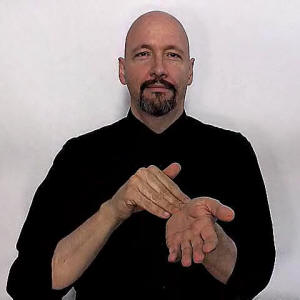
Randy,
Uh huh. And an "M" for "medic" is less English how?
No need to answer that. Read below.
I've seen the argument presented dozens of ways.
But really, it is not a regional thing -- it is an "anti-English"
backlash/rebellion/independence thing.
It is comparable to the Gay Community [circa: 2010]
[update: LGBTQUI2S+ Community (2021)] reclaiming the word "queer" and wearing it on their
shirts and using it in their organization names.
Avoiding initialization is a way of proclaiming "I'm Deaf and proud and you (and your English) don't own me."
It is zeitgeist (the spirit of the day) to reclaim any "initialized
sign" that could (reasonably) be done without an initial.
This is
often attempted or accomplished by labeling commonly initialized
words as Signed English -- thus instantly stigmatizing the
initialized word.
I suggest to you though that there is a difference between Signed
English and "over initialization."
There's a fellow I know who feels initializations are okay
but only if they were introduced before the 1960's.
Instead of signing "OFFICE" he signs "WORK BOX-(room)." I
personally think that is extreme. [Update: Personally?
I like to spell O-F-F-I-C-E. It rolls off the fingers very
nicely!]
Some of the favorite targets for "de-initialization" are the signs
"doctor, breakfast, lunch, dinner, system, vocabulary, and free."
For example you will see people (particularly ASL instructors) signing "eat night" instead of
DINNER (with a "D" hand).
To try to put some perspective on this I started asking such
people how
they do various commonly initialized signs. (See the list of signs below.)
After a bit it becomes very obvious (to them) that they use PLENTY of
initialized signs and that initialized signs are entrenched in ASL.
So the question becomes, "What qualifies BLUE to be ASL but DOCTOR
(with a D) is relegated to Signed English?"
No, seriously ask your friends and contacts for a list of characteristics of why it is okay
to sign "W" on the chin for "water" but not a "D" on the wrist for
"doctor."
The answer generally proffered is: "We already have a sign for
'doctor' whereas we have no good alternative sign for 'blue.'"
But that fails to answer the question why "BLUE" isn't
English and "DOCTOR" is.
The "D" version of "doctor" maps to a contemporary version
of the English word doctor. The "bent hand" version of
"doctor" started as an "M" which maps to "medic" which is an older
way (in English) of expressing the concept of doctor.
Already having a sign for doctor (based on
medic) doesn't automatically mean that the initialized sign for
doctor is English. What it means is that you now have two signs
for doctor, one of which looks less like English than the other one
and since English is the "got cooties" of the Deaf world these
days you'll find many ASL instructors throwing
stones at the sign that looks more like English.
Here's the funny thing. If you ask a group of ASL Instructors
"how do you sign doctor?" They will
generally show you the "bent hand" version and/or show you both
versions and
then "educate you" that the "bent-hand" version is "more" ASL.
Then if you go to a Deaf community event and ask average Deaf folks how
they sign
"doctor" the vast majority of them sign it with a "D"!
Then when you go back to the ASL instructors and show them a video
of various Deaf people signing doctor with a "D" the ASL instructors
will tell you "Oh, that is because those pour souls have had their
language bastardized by their (Hearing) interpreters and (Hearing)
teachers while growing up. They don't sign 'real ASL' like I do."
[Update: A new, interesting question to ask is, "How did you sign
'doctor' when you were younger?"]
So, you tell me, which version is more "ASL?" The
sign that is occurring with the higher frequency at Deaf events
throughout America, or the sign prescribed by various ASL
instructors??? [Update: Including me.]
The thing about languages is this: If enough people DO jump on
the bandwagon and start signing the BENT-hand version (based on "M"edic) instead of
the "D"-hand version (based on "D"octor), at some point
the "D"octor sign really does
become the "wrong" sign. This is simply due to the fact that
languages are about consensus. At some point if 51% of
the Deaf community starts signing doctor with
"a BENT-hand" (a modified "M") then that sign should be
listed as the "main" variation and the sign "D"octor should be
listed as a secondary variation. At some point if so few
people sign "D"octor that the majority of the Deaf community would
not easily recognize it out of context then I'd say the sign is
actually "wrong." Time will tell.
Cordially,
Dr. Bill
[Edit / update: Heh...time did tell: I updated my "DOCTOR" page to list the
BENT-hand version first. Language evolution! YAY!]
Dr Vicars:I have contacted you several times in the past few years.I took my SLPI for the first time in April. I got Survival Plus. (Which KILLED me). The scorer, _________ of the WPSD, took off major points for "overuse of initialized signs". He listed 1. BASEMENT. Which I totally knew better than. But that B hand just slipped out. 2. LIFE/LIVE. I know that the pointy finger can be tucked in for LIVE, but tons of Deaf use the L hand for that sign. Anyway, I retook it last month (advanced, thank you very much), and AGAIN he cited my "overuse" of the dreaded initialized sign. This time, he cited my D hand in DECISION. I don't even know the alternative to using the D hand for that. I think he has a bee in his bonnet regarding the issue. Do you have any thoughts on this?The first time I broached this issue with you was the R hands in RESPONSIBILITY. Thanks for addressing that at your wonderfully helpful site. It's my GO TO site for a dictionary. I only go to ________, if you don't have the sign listed.I hope we get to meet one day.Fondly,
Mian D.
Notes: