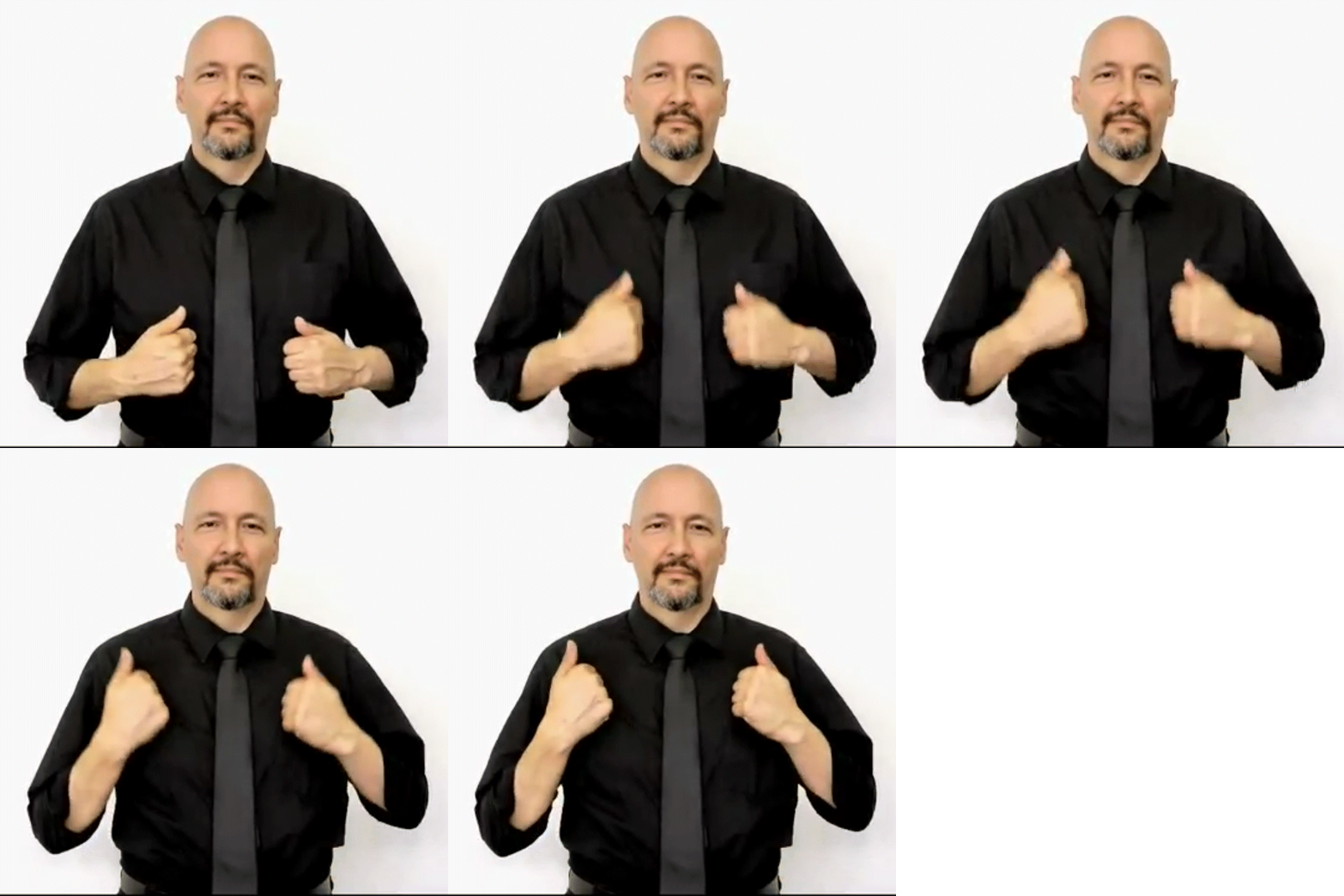
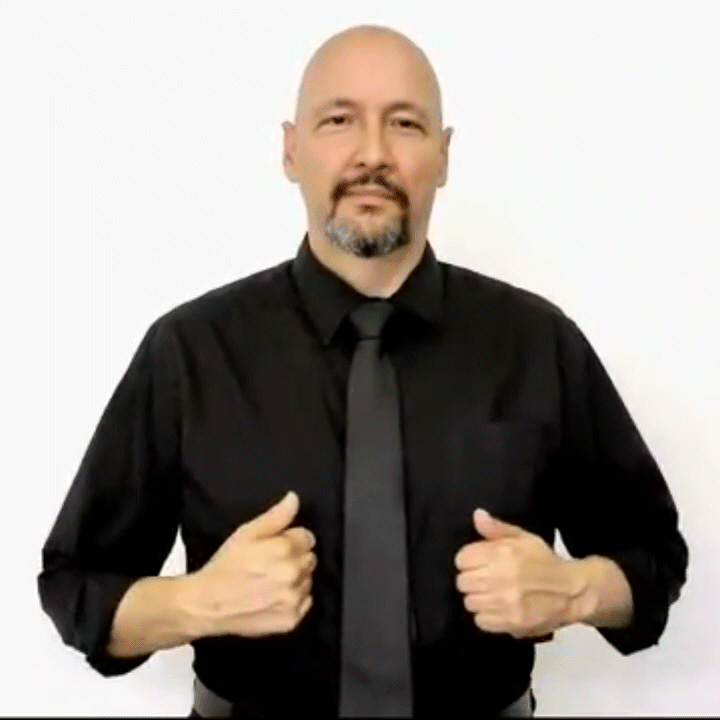
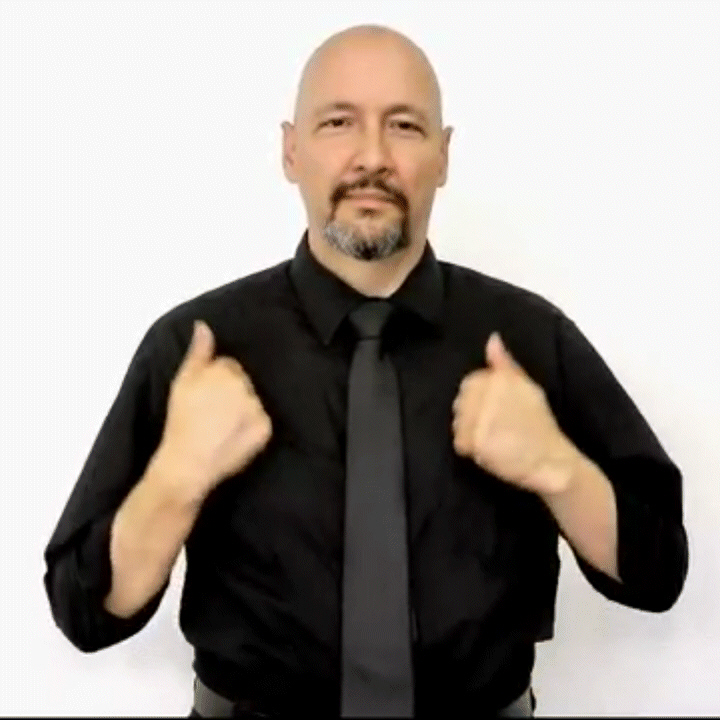
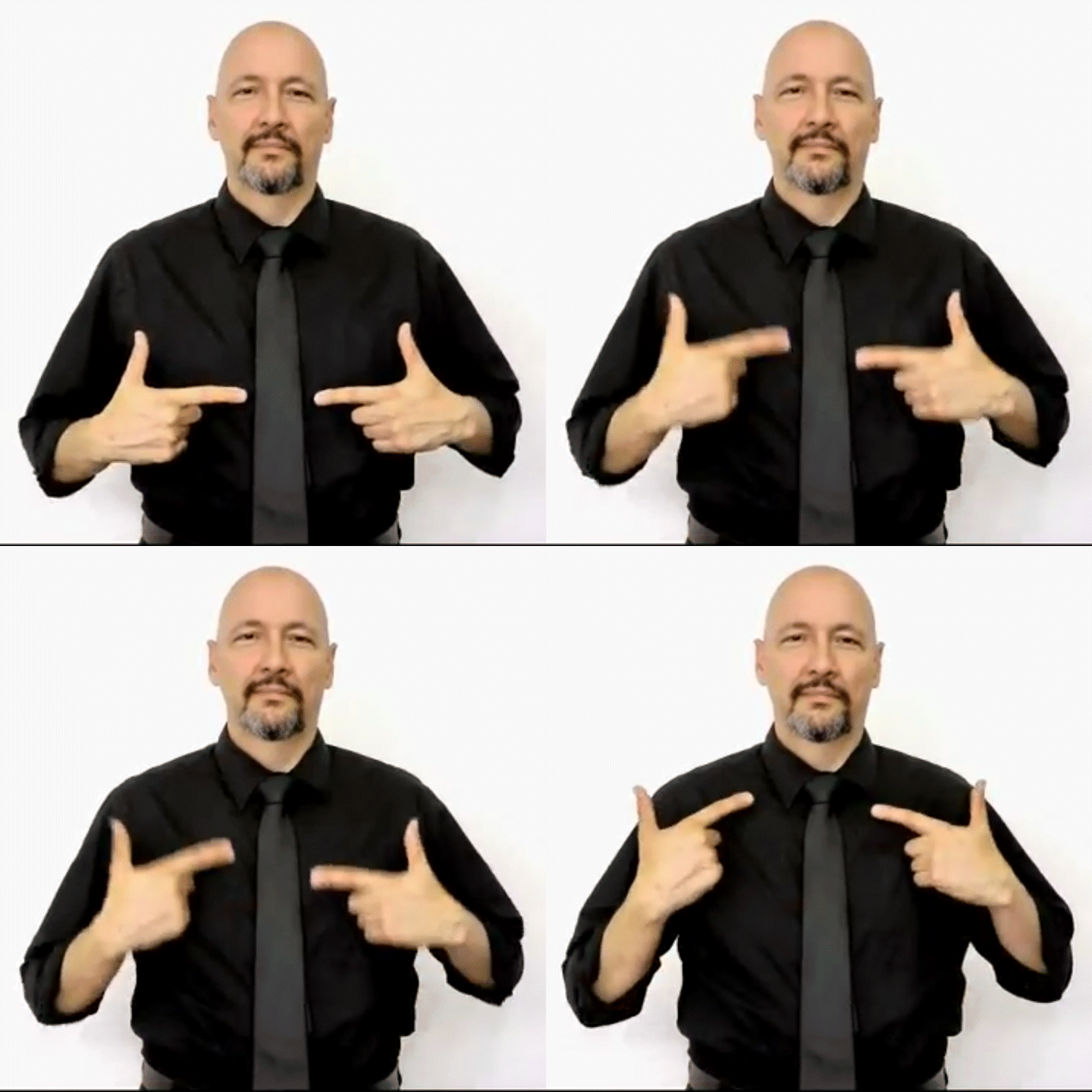
LIVE / survive / alive / address
YOUR ADDRESS WHAT?
Notes:
An individual I know insists that the sign ADDRESS should always be done with a double movement to mean "address" otherwise it will mean "live." Her husband however isn't convinced. Neither am I. So, if you ever take her class make sure to do it her way (using a double movement) since she will be giving the grade.
Technically though, she has a good point. Nouns of noun/verb pairs (like ADDRESS-noun & LIVE-verb) do tend to use a double movement. On the other hand, high speed signing often drops repetitive movement. For example, the combination of the signs "EMAIL ADDRESS" almost always drops the "double movement" of the sign ADDRESS.
If you do the sign ADDRESS in isolation you tend to use a double movement. This sign really isn't worth arguing over since you can see expert signers doing it either way.
Note: Some people do the sign "LIVE" using "L" handshapes on both hands (This is an example of "initialization"). Again. Not worth arguing about. But if your instructor or friend likes it a certain way, do it that way.
LIVE / ADDRESS / / LIFE / SURVIVE:
Note:
The sign "ADDRESS" can be used to mean several concepts like: life, life, and survive.
It is similar to the "live" sign, except instead of using "L" hands it uses "A" hands. The "A" handshape version of this sign can actually be used to mean "live" as in "Where do you live" = "YOU ADDRESS WHERE?"If you want to know where someone lives currently, you could sign, "YOU ADDRESS/live WHERE?" (using a single movement on the sign "ADDRESS/live") Which would mean "You live where?" and/or Where do you live?
YOU LIVE WHERE?
So, keep in mind that you can use the sign "ADDRESS" to mean either "address," "live," "alive," or even "survive."You might see people sign "ADDRESS" to mean "alive." As in, "HE STILL LIVE?" (Meaning, "Is he still alive?") Or you could use the initialized "LIVE" sign for that.
If you need to make a distinction between ADDRESS and LIVE treat this sign as a noun/verb pair and sign:
ADDRESS: double movement (smaller movement done twice)
LIVE: single movement (larger movement done once).
LIVE:
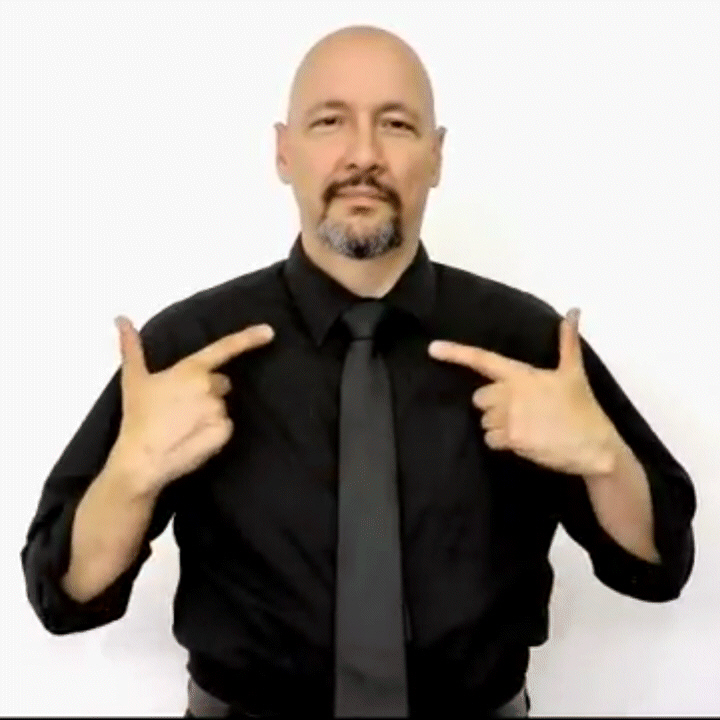
(initialized version)This version of "live" is "initialized" with an "L." It cannot be used to mean "address."
Use a single movement, straight up.
Question: A student asks: "How would u sign "life"? is it the same thing as "live"?"Answer: You could sign life the same as the initialized form of LIVE but if you plan on taking an ASL test any time soon I recommend you simply do the version of the sign that uses "A" handshapes. That one sign can mean: Address / live / life / survive.
Note:
If you want to know where someone is from, you would sign "WHERE FROM YOU?
See: "Where are you from?"
OPTIONAL DISCUSSION / no need to read beyond this...
Question:
A student asks: "When speaking English,'live' as in I 'live' in Canada, is pronounced differently than 'live' as in the show was taped 'live.' Is there a different sign for the latter form of 'live' or do we use the same sign for both?
Answer:It seems to me that unless you are recording cadavers and corpses -- "all" recording (of humans) is "live."
The concept of a "live recording" isn't about recording someone who is alive but rather it is about recording something that is that is happening in front of a "live" audience rather than in a studio or without an audience.
If the point of using the word "live" is to inform others that a recording or broadcast is happening in front of an audience then we can assume that the audience is "alive" and instead focus our signing on the fact that there is an audience. We can choose to sign something to the effect of THAT VIDEO-record DURING performance-[ACT/acting] FOR AUDIENCE.
You can modify that signing by using "HAVE" instead of "FOR." Or you can add "TRUE" (to mean actual) or even "TRUE-BIZ" to mean "real / indeed / actual / skin in the game, etc. You could add the "FACE-to-FACE" sign to mean "in front of" or you could use classifiers and depiction to show the positioning of the performer in relation to the audience. You could sign "PEOPLE THERE" (instead of audience). As you can see there are quite a few ways we could sign approach this but the general concept is of making it clear that there was someone watching the performance.
Related to this discussion is the concept of a "live broadcast."
A "live broadcast" may of course be recorded for later playback (or broadcast and "not" recorded).
To describe a "live" broadcast you could sign something to the effect of "THAT HAPPEN NOW!" (the sign "NOW!" would use a double movement and perhaps somewhat straighter elbows as in "right now!")
An other approach is to simply spell "live." It is a very easy word to spell. When spelled at high speed it will mutate a bit. The "L" and "I" will overlap. The "V" will change into a two-fingered "E" version. At one point during the spelling of LIVE you may even see the "L," "I," and "V" all overlapping at the same time.
Or rather "you" won't -- but a high frame rate camera will and you can then play back the spelling in slow speed and see the "coarticulation" as it happens.
The fingerspelled version of "LIVE" (when used to represent the concept of "actually happening now") is every bit as legitimate as any other approach to discussing a "live broadcast." Indeed, "fs-LIVE" is actually a better choice if you are discussing a "live broadcast" that will happen in the future or a live broadcast that happened in the past.
For example:
TWO-WEEK-AGO THAT VIDEO-record SPREAD fs-LIVE! (Two weeks ago that was broadcast live!)
Also, worth mentioning here is that just because some bald guy online (who happens to be Deaf/hh have a Deaf wife, a doctorate in Deaf Ed, and decades of teaching experience) tells you to spell "live" when referring to a "broadcast that is happening in real time" (or will or did happen in real time) that is "not" the end of the story. The fact is language users often mangle words and signs and if the mangled sign is used often enough, long enough -- it becomes the new normal.
Additionally not all are signers are concerned about sticking to or following any particular prescription as to how we are "allowed" to go about creating meaning. There are plenty of signers who will happily sign the two-handed "A" hands version of "LIVE" (or, "gasp" even the "L" hands version of "LIVE") to express the concept of "live" as in a "live broadcast."
A friendly tip for "Hearing" people reading all this "helpful" advice regarding signing: If you see a Deaf person signing "LIVE" to mean "happening now" or "with an audience" it is not your job to lecture the Deaf person on the "right" way to sign "live" -- unless the Deaf person has paid you to do so. (Good luck with that).
Just because you learn something new in class, a book, or online doesn't grant you the societal right (in the Deaf community) to lecture (without consequence) a Deaf person on our signing choices.
Let me put that in simple terms:
Deaf can tell "Hearing people" how to sign but if "Hearing people" want to get along in the Deaf community they will avoid telling Deaf how to sign.
(That's just the way it is in societies.)
Dear Dr. Bill,
I am presently taking an ASL class (this time at a Community College with Gallaudet professors, reason why going there, for them as teachers!) and am having some problems with the WAY they are teaching this course. I've taken private lessons from a Gallaudet alumni who teaches in small groups, is a storyteller, signs BEAUTIFULLY (OMG!), and in 2002 was taking this SAME EXACT course (at the same college, but with a VERY different book - and teacher)...anyway...in one of your lessons you state that it is okay to sign, "WHERE FROM YOU?"
I have always been taught that in ASL the English question:" Where are you from?" would be translated into ASL as:
"You from where you?" as opposed to "Where from you?"
I can deal with the new signs and different meanings for the same sign, but I'm getting so confused due to learning from so many different people, all whom seem to have different ideas of how to TEACH sign, all are Native ASL users, and they are also using different ways of forming "sentence" structure, which is the MOST confusing to me.
-- Name on file
Dear Student,
The concept of "Where are you from?" is typically expressed by advanced signers by signing "FROM YOU?" while furrowing your eyebrows.
In "that" specific question (Where are you from?) the concept of "WHERE" can easily be expressed by the furrowed eyebrows -- without needing to use the WHERE sign. Sure, you can add the sign WHERE to the signs FROM and YOU, but it is not needed.
In general in ASL we do tend to put "wh" type signs (WHO, WHAT, WHEN, WHERE, WHY, & HOW) at the end of question sentences.
To understand why we do this it helps to realize that it feels strange and/or uncomfortable to hold a WH facial expression (furrowed eyebrows) for the duration of a medium length or longer sentence (four signs or more).
So, for longer sentences we tend to move the WH question to the end.
The facial expressions we use in ASL to form questions are the equivalent of how Hearing people raise the tone of their voice.
Here is the thing to understand though, when Hearing people ask very short questions, they raise the tone of their voice throughout the whole question.
They do this because the meaning of this very short utterance is actually made more clear by using the raised tone of voice throughout the whole sentence (since the duration is so short). Try it yourself. Say "Are you GOING?" and only emphasize the last word. Then say it again and emphasize all three words, "ARE YOU GOING?"
You will probably think that it feels "weird" to try to say "Are you" (normal voice) and then switch over to "GOING?" (high tone) for just the last word. It feels "better" to just say all three words in high tone since the sentence is so short. It is more smooth and less jarring to use one tone for a short sentence than to try to cram two different tones into a three word question.
The same thing applies to real life signed conversations. Short questions can and often do place the WH-type sign at the beginning of the sentence since it becomes more smooth and "economical" to form one facial expression for a three-sign sentence using a non-topicalized sentence structure than it is to form two different facial expressions for a 3-sign sentence using a topicalized sentence structure. Or the "WH"-type sign is dropped altogether. For example, when asking "What time is it?" -- people often just tap their wrist twice while furrowing their eyebrows.
Go to a Deaf event at which there are parents and children and you will see phraseology such as: "WHERE MOM?" used to ask "Where is your mother?" and/or "Where is mom?"
Many ASL teachers (even the really "good ones" who sign "really well" and teach at prestigious universities) have pre-conceived notions and/or biases that prevent them from wrapping their minds around this principle. Some teachers are so preoccupied with trying to make sure ASL doesn't look like signed English -- that they move all WH-type questions to the end of every sentence, whether it is warranted or not.
Cordially,
Dr. Bill



*
Want to help support ASL University? It's easy:
DONATE (Thanks!)
* Another way to help is to buy something from Dr. Bill's "Bookstore."
* Want even more ASL resources? Visit the "ASL Training Center!" (Subscription
Extension of ASLU)
* Also check out Dr. Bill's channel:
www.youtube.com/billvicars
You can learn American Sign Language (ASL) online at American Sign Language University ™
ASL resources by Lifeprint.com © Dr. William Vicars
