The sign for "taste" touches the tip of your middle finger to your
lips.
If you do the movement once it is a verb as in "Taste this and tell me what
you think."
If you do the movement twice it is a noun as in, "That is a good flavor."

TASTE:



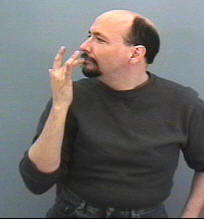
Take a taste of:

If you wanted to describe how something tasted here are some variations:
TASTE AWFUL:
TASTE GOOD:
TASTE GOOD-[thumbs-up]:
TASTE TERRIBLE:
If you mean "TASTE" as in "to have or get experience" one way to convey that concept is to use the sign for EXPERIENCE:
EXPERIENCE:
?
If you mean "TASTE" as in "to test or try" one way to sign that is to use the sign for TRY:
TRY:
?
If you mean "TASTE" as in "a feeling or sensation resulting from an experience" (a compromise that left a bad taste in their mouth) one way to show that is use the sign for FEEL:
FEEL:
Sentence: "Do you think coffee tastes good?"
= YOU THINK COFFEE TASTE GOOD?
Notes and discussion. The information below is NOT needed for ASL 1 or ASL 2
classes!
Question:
On Wednesday, May 15, 2024 an ASL student writes:
In lesson 27 on the Lifeprint course we encounter the sign for TASTE, with a
bunch of variations:
https://www.lifeprint.com/asl101/pages-signs/t/taste.htm
One variation not listed on that page is when we want to use Taste as in the
sentence, "She has great taste in art."
Is there a sign for that meaning of the word?
I can't even think of a synonym that might have a relevant sign.
Warm regards,
- ████
Hello ████!
The phrase "great taste" in the sentence "She has great taste in art" is an
English idiom. That phrase works well in English because the word "taste"
has expanded or stretched to mean more things than tasting things with one's
tongue.
The question we need to consider is "Can ASL do the same thing English has done?
Can ASL expand the meanings and common usage of the ASL sign TASTE?"
Let's dig into this a bit:
The phrase "great taste" doesn't refer to the literal sense of taste (as in the
flavor of food). Instead, it means having a well-developed sense of what is
good, appropriate, or of high quality in a particular area, such as art,
fashion, or music.
Idioms are expressions that have a figurative meaning separate from the literal
meaning of the individual words. In this case, "taste" is used figuratively to
describe a person's judgment or discernment.
First let's consider if TASTE has already expanded in meaning beyond referring
to the sense of taste in the mouth. Then we will consider if TASTE has
expanded in meaning enough to be commonly accepted for use in an idiomatic
phrase such as "great taste?"
It is likely that the sign FAVORITE evolved from the sign TASTE.
We see videos of people signing FAVORITE and TASTE in which if we were to do
screen grabs of the frames and remove all other context prior to and after the
signing of one of those two signs -- many of our examples would overlap and we
could not state with certainty which meaning was being intended.
The fact that we can choose to articulate the sign TASTE more clearly and
specifically nearer the lips does not change the fact that everyday casual
signing the sign TASTE often (not always but often) looks indistinguishable from
FAVORITE. While it is true that FAVORITE often uses two movements that is not
always the case -- particularly when it occurs in the middle of a sentence
during high speed signing.
Additionally, we can further distinguish the sign TASTE by doing it with an "L"
hand but that still doesn't mean that some of the time the signs TASTE and
FAVORIATE look the same and thus the argument can be made that one of the
versions of TASTE and one of the versions of FAVORITE are "homonyms" -- or in
the case of a visual language -- icononyms. That means they look the same but
have different meanings.
Consider for example that most skilled Deaf signers would easily recognize the
signed phrase, IX-(that-person) NOT MY TASTE as meaning "He's not my type."
(Context: the signer is pointing at a guy or pointing to an absent referent of a
previously identified male).
TASTE can be and often is used to describe a set of characteristics, attributes,
or qualities that a person looks for in a potential romantic partner (such as
physical appearance, personality traits, interests, values, and beliefs). In
other words TASTE can be to refer to a person's preferences thus we can see how
the sign TASTE evolved to include the meaning of "prefer" and sometimes be
labeled as PREFER.
If you have a preference for something that thing is your favorite -- thus we
can see why TASTE is often glossed (written or typed) as FAVORITE.
FAVORITE then evolved to include the meaning of FAVOR (as in "Will you do me a
favor?").
At the 11:20 mark of the "GallaudetU" YouTube channel's interview of Dr.
Caroline Kobek Pezzarossi we see her using TASTE to mean "a brief experience or
sample of something" in the sentence "That was my first taste of leadership and
I really liked it."
https://youtu.be/IpvV6Lm8tkg?t=679
In the above example the sign "TASTE" is being used as a metaphor referring to a
person's initial exposure to or experience with being in a leadership role.
Here, "taste" does not refer to the literal sense of taste (as in the flavor of
food) but rather to a small or initial experience that provides someone with an
idea of what something is like.
So we are seeing the following expansions of TASTE:
TASTE =
favorite
preference
type
exposure
try
I texted Certified Deaf ASL Interpreter (CDI) Sean Benson to ask how he would
sign: "She has great taste in art."
He texted me back with: "Her art preference champ!!"
That might be glossed as: HER ART PREFER CHAMP!
However, it could also be glossed as: HER ART TASTE CHAMP!
Labels like PREFER, FAVOR, FAVORITE TYPE, ect. are all just labels for the same
underlying sign: TASTE
We can make a case that the use of TASTE in a sentence such as "She has great
taste" is commonplace and normal but the English gloss (or in other words "the
label") might vary.
The real example of skill here is the fact that the CDI chose CHAMP instead of
WONDERFUL to represent the concept of "great" -- in the context of "She has
great taste in art." Another indication of skill here is the choice to
restructure the sentence into using a possessive palm version of "HER" rather
than signing something like "SHE HAVE." While either one would succeed in
conveying the meaning it is interesting to notice the smooth flow and efficiency
of the construct "HER ART PREFERENCE CHAMP."
Of course there are many different right ways to interpret a sentence such as
"She has great tasted in art." The best interpretation is going to depend
significantly on the fluency of the person with whom you are conversing.
Skilled interpreters may choose interpretations that can more easily be
converted into English (and back) for situational reasons or for a desire to
keep an English idiom intact.
There are those who despite the above examples and logic will still argue
against the use of the sign TASTE in regard to skill in making fashion choices.
They might suggest to you signing something along the lines of: HER FASHION
CHOOSE (alt) CHOOSE SKILL!
Or "CHOOSE (alt) CHOOSE ART, SHE SKILLED SHE!"
(Or CHAMP, or WOW, or some other adjective praise.)
The fact that some people might prefer to avoid using signs the labels of which
overlap with English words -- but that doesn't change the fact that a
significant number of skilled Deaf signers do use the sign TASTE in ways that
are figurative rather than just literally using the tongue.
Warm regards,
Bill
_________________________________________
Lexicographers field notes:
I've just been digging up video examples of Deaf (or their partners) signing
TASTE and the majority are using firm jabs on the chin with the tip of the
middle finger (similar to one of the versions of the 25-hand). A few are a bit
higher near the bottom lip. A couple are "L" hands or "index" fingers (which I
think could be an excellent backup plan for when a person needs to sign "prefer"
and "taste" in the same sentence. (I prefer the taste of dark chocolate.)
Additional references and notes:
Example of TASTE being signed on the chin: https://youtu.be/6t39_cvniGg?t=1987
33:07
Example of TASTE being signed on the chin: https://youtu.be/8NRDuefNAB8?t=730
12:11
Example of TASTE being signed on the chin: https://youtu.be/JwUD1lMIXgk?t=526
8:46
Example of TASTE being signed with an "L" hand: https://youtu.be/xNm38yv_uns?t=53
00:54
Example of TASTE being done on the CHIN by alternating hands and being used to
mean "Try many things / become familiar with many things." https://youtu.be/P8USfnEaNig
4:38
Example of TASTE being signed as a noun using a double movement: https://youtu.be/s2BnofMTYwg?t=198
3:19
Example of TASTE being signed a as a noun using a double movement specifically
on the chin: https://youtu.be/dtxC6Zf2yk0?t=69 1:09

"In good taste" is an idiom.
Phrases like, "You have great taste in art"
are similarly idiomatic -- unless you are licking the art.
If your "AI" is telling you something
different you need to use a smarter AI (for example, instead of ChatGPT try
"Claude 3 Opus") and cross-check your results using a respected, authoritative
reference such as the Merriam-Webster dictionary.
I had to tell ChatGPT to go check a
dictionary:
Notes:
Also see: PREFER / favorite
Notes:
Where this sign is taught:
Taught in Lesson 07.Reviewed in lessons: 36
Practice sentences using this sign:
YOU THINK COFFEE TASTE GOOD?FOOD YOU THINK TASTE AWFUL, WHAT?