The general, casual, typical sign for 3 (THREE) in ASL:
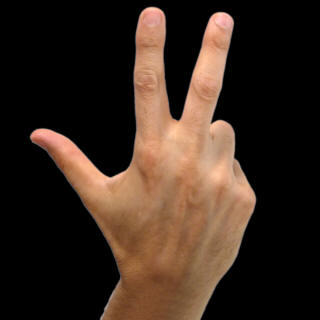
When done as casual, isolated signs, numbers "1 through 5" are typically
produced palm-back by native Deaf adult signers.
For example, if someone asks you how many brothers you have and you have "3"
then you would reply by holding up the number 3 with the palm facing
backward.
However, the palm should be forward when doing a two-or-more-digit number
such as "53," or a series of numbers such as a phone number, the time of
day, ages, and if you are trying to emphasize a point. Tip: During class
sign however your local teacher wants you to for your grade. Out of class
pattern your signing on local native Deaf adult signers.
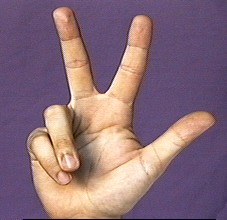
The palm forward version of THREE (below) is also very common but takes a very,
very tiny bit more effort (you have to position the palm outward) to produce
than the citation / unmarked palm-back version of 3 (above). Both
versions are correct. The palm forward version is just slightly more inflected
than the palm back version. The palm forward version commonly shows up
when you want to emphasize the number 3 or if you are doing a series or string
of numbers that includes the number 3.
Notes:
An ASL learner writes:
On Thursday, August 17, 2023 at 03:08:05 PM PDT, V Bradley <████████@gmail.com>
wrote:
Greetings Dr. Bill,
I'm not sure if asking you directly is the best way to find an answer, and in
any case I'm sure you're very busy, so I totally understand if I don't receive a
response. But I have a question regarding the particular way to make a sign:
when I sign the number 3 I find it easier to make the sign for the letter W but
with my palm facing me, rather than the "official" sign of extending the thumb,
forefinger, and middle finger into an L sign. Is doing so likely to cause
confusion, or would you say it's within an "acceptable" range of variation from
the standard sign?
I am not deaf or hard of hearing myself, but I've just started looking through
the Lifeprint courses and am teaching myself ASL. So far your courses are very
understandable and clear, so for what it's worth from a layman's perspective, I
would praise your project very highly.
Best regards,
Ben
Ben,
I recommend you work on doing the regular number 3 consisting of the thumb,
index, and middle finger.
ASL is a pretty flexible language but the flexibility doesn't extend so far as
to allow a palm-back-W to function as a 3 in typical signing situations.
If you were missing a thumb, you'd be stuck doing a 3 with the W handshape but
if you have a thumb (and an index and middle finger) skilled signers are going
to expect to see a traditional "3."
Warm regards,
+ Bill
________________________
William G. Vicars, Ed.D.
ASL University (Lifeprint.com)
BillVicars@aol.com
¯¯¯¯¯¯¯¯¯¯¯¯¯¯¯¯¯¯¯¯¯¯¯¯
index-old.htm
matrix-for-sign-pages (_matrix.htm)
Notes: