The other day I got a video message from a video relay interpreter.
She used the "I am..." sign -- as in "I am interpreter number 675..."
Of course the "I am..." sign has been around for longer than I've been alive -- but (at the time of this writing) I've never seen it documented in an ASL textbook. So I'll share some thoughts on the sign here:
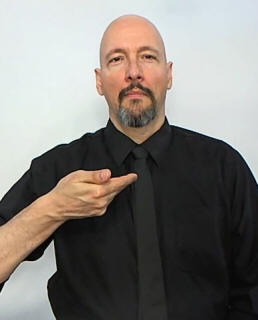
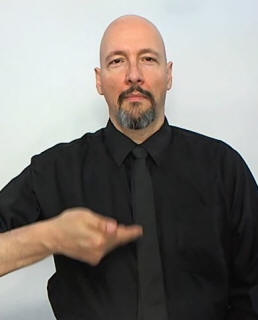
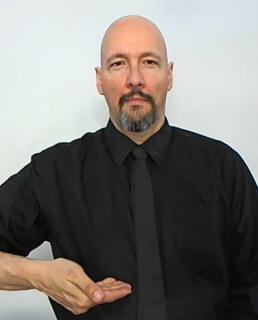
The "I am" sign is done by pointing to your upper chest area with a slightly bent hand (or even a flat hand, but at this angle the slight bend works well) and then smoothly move your hand down the length of your torso. You don't make contact with your body -- rather you just use a sweeping gesture. If you are up on stage or in a theatrical or boisterous mood then do the sign larger (further down the body) and/or use a flourish at the end.
"I am ..."
Usage Notes:
I wouldn't do this "I am" sign if I were meeting someone one-on-one or in an in-person small-group setting.
The relay interpreter who used it did so in a setting where she was just matter-of-factly stating that she was "to be known as" "interpreter 675."
If you meet someone and want to tell them who you are you should generally just point to yourself with an index finger and then spell your name (and add your name sign if you have one).
The "I am" sign is good for such meanings as:
* "You may call me Franscisco"
* "I am known as..."
* "I'd like to present myself, I am..."
* "Moi"
* "By way of introduction I am..."
* "Ladies and Gentlemen, I am..."* "Allow me to present myself, I am..."
Question: Is the "I-AM" sign honorific?
Response: The "I-AM" sign can be honorific but as of the early 2020s it would seem that many people simply use the "I-AM" sign as a way of introducing themselves -- thus it is not always honorific.
An instructor in a graduate-level ASL-teaching program surveyed 21 students regarding their use of the "I am" sign. Apparently "8" out of "21" were using or would use the "I am" sign to introduce themselves.
The above example was from an academic course being participated in by individuals who are intent on becoming ASL teachers. These were not novice signers -- rather they were experienced signers -- able to participate in high-level ASL discussions regarding complex topics.
The sample size was relatively small and the survey was anecdotal (a story relayed by the person doing the survey) yet I would propose to you that if one-third of a population signs something that suggests it is fairly common and fairly well accepted.
At some point ASL teachers need to decide if they are going to be a "descriptive" teacher and describe what they are seeing modeled in the Deaf Community or if they are going to be a "prescriptive" teacher and hand out "prescriptions" regarding how they think their students should be signing irrespective of what is actually being signed in the Deaf Community.
Language changes, evolves, and adapts.
I'm going to post a bunch of citations with time-coded links pointing to highly skilled signers (most of whom are Deaf) using the "I-AM" sign.
Even if these links become inactive at some point in the future the point remains the same: The "I-AM" sign is common and used rather casually by Deaf to introduce themselves -- particularly to groups or online.
See the 2 second mark of:
https://youtu.be/VSfgzF_mAu4?t=2
(I am Mikey Krajnak)
The 4 second mark of of https://youtu.be/ICBGc3FXFyQ?t=4
Hello, I am Howard Rosenblum, CEO of the National Association of the Deaf, NAD.
0:11 of https://youtu.be/MXphW5AeCHU?t=11
(I am Gianna)
7:41 of https://youtu.be/CCezOxy61_E?t=460
(Hello, I am Regan.)
0:05 of https://youtu.be/RvcVCeU_7xI?t=5
(Shane Feldman, RID "I am ...")
0:54 of https://youtu.be/8QYiVSltL6s?t=53
(I am Susan Schatz and this is Mary Ann Kinsella-Meier)
0:03 of https://youtu.be/ao3GKaJ8UXk?t=3
(Hello, I am Darren Holst, Vice President of OAD.)
0:03 of https://youtu.be/jC7FryogM1o?t=3
(Hello, I am Sasha Ponappa.)
0:10 of https://youtu.be/NtY2QpLPqOs?t=10
(I am Lisa Anderson-Kellett.)
See the beginning of https://youtu.be/RYu3o5wEzKc
(Hi, My name is Thomas Koch) Then see
(I'm Liz Jarashow) at 2:46
(Hello! I am Matthew) at 2:50
(I'm Bobby Barden) at 2:53
0:04 of https://youtu.be/0VA-_MjXS8I?t=4
(Hello, I am Anna Witter-Merithew, the current interim Executive Director of RID.)
1:25 of : https://youtu.be/gnPF73VokmU?t=85
(Hi, I am Kellynette Gomez.)
1:53 of https://youtu.be/gnPF73VokmU?t=113
(Hi, I'm Ericka Baylor,)
0:10 of https://youtu.be/gnPF73VokmU?t=10
(I'm Bobbi Cordano, President of Gallaudet University.)
Upon reviewing current usage in the Deaf Community it would seem that the use of the "I am" sign is not always honorific these days and is rather commonly used by many people to simply introduce themselves. ASL teachers can either resist common usage and give advice based on "the good ol' days" -- or they can teach what is actually being used widely and commonly in the Deaf Community right now.
Notes:
According to Merriam Webster (or in other words "the dictionary") "honorific" as applied to words (or in our case -- signs) means the word is used to show respect, courtesy, or acknowledgment of someone's social status, rank, or title.
The point of my post is that the "I-AM" sign is commonly being used in a way that doesn't (!) indicate "respect, courtesy, or acknowledgment of someone's social status, rank, or title" but rather is simply a way of saying "let me introduce myself to you" or even just "I am."
IMHO: The ASL sign "I-AM" is generally NOT honorific. "I-AM" may tend to be used in certain registers or circumstances of signing but that is not the same as being honorific.
There are teachers out there informing their students that they (the students) should "not" (as in implying "never") be using the sign "I-AM" to introduce themselves. Yet in real life many Deaf in online videos do it. It is very commonly done.
Thus maybe instead of teaching that "I-AM"
is honorific -- we might create better interpreters and signers by teaching that "I-AM" is fairly commonly used in public facing (often asynchronous) situations of introducing yourself from "one to many". Then maybe also suggest right afterwards that it is safe to just point at yourself and then spell your name and share your name sign if you have one.
I suppose an issue here is that the vast majority of people discussing ASL want a quick and easy way to categorize the "I-AM" sign without explaining that the sign tends to appear in "formal introduction register," "consultative register," "public-facing professional speech," or "performative introductory speech."
Later, when I get some time and if I feel like delving into this a bit more, some of the concepts I'll look into include: Social Deictic Distance, Front-Stage Language (Erving Goffman?s Dramaturgy), and Prosocial Transactional Phrasing.
The fact is -- it is much easier to just "mislabel" "I-AM" as being honorific
than labeling it (something to the effect of) I-AM-[public-facing-formulaic-one-to-many-opening-version].
Likely because the sign was historically (and by many still) labeled "honorific," some teachers seem to be enforcing the dictionary definition of the English label "honorific" rather than observing the pragmatic reality of the ASL sign. In real life, the sign appears to have undergone semantic bleaching -- losing any strict vertical status markers (rank/elevation) and transitioning into a broader pragmatic marker used rather commonly for asynchronous broadcasting -- particularly one-to-many broadcasting. Thus perhaps a "consultative" register on up to formal and frozen (but not necessarily honorific in nature).
I wouldn't use it during a one-to-one Zoom call but I "might" use it at the beginning of a webinar.
Interestingly though we see videos of people who locally are chatting very casually and doing a very casual "let's do a 'hello' video to others interested in our
topic" -- and proceed to use the "I-AM" sign to casually introduce themselves to people they consider to be "friends that they just haven't happened to meet yet".
-----------------------------------
Notes: