DINOSAUR: The
American Sign Language (ASL) sign for "dinosaur"
The sign for dinosaur uses a flattened "O" handshape to show a dinosaur walking past. The arm bounces up and down a bit (as if taking steps) as it travels in front of you.
DINOSAUR:
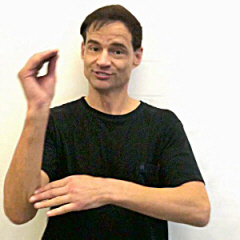
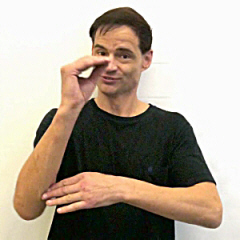
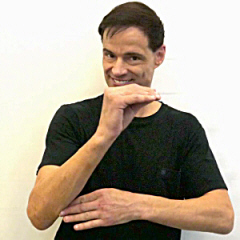
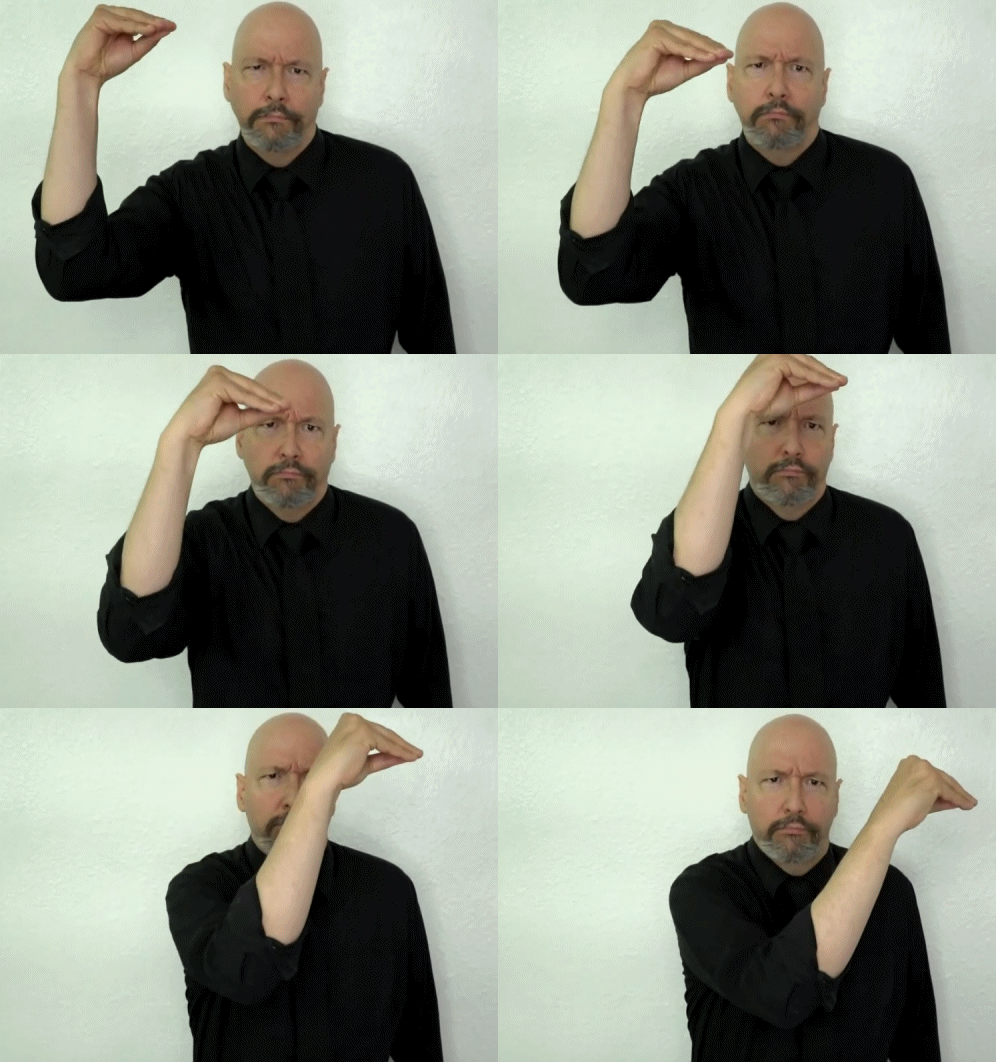
[Special thanks to ASL Model: Christopher Palaia,
Native ASL Deaf Signer / Deaf Interpreter / Advanced ASL instructor]
Just as some dinosaurs evolved and others died out -- some signs
evolve and others die out.
Over time ASL has been evolving away from overlaps with "Signed English."
One such evolution is discontinuing the use of unnecessary
"initialization" of signs. An "initialized" sign uses the
initial letter of an English word as the handshape of a sign.
For example, when I grew up (not quite in the dinosaur time period)
it was common to initialize the sign for dinosaur with a "D"
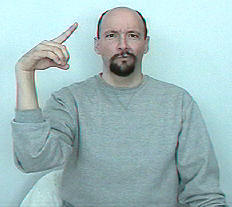
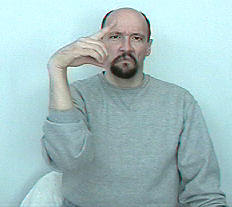
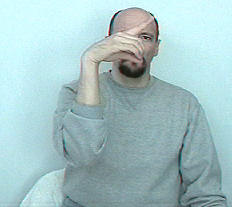
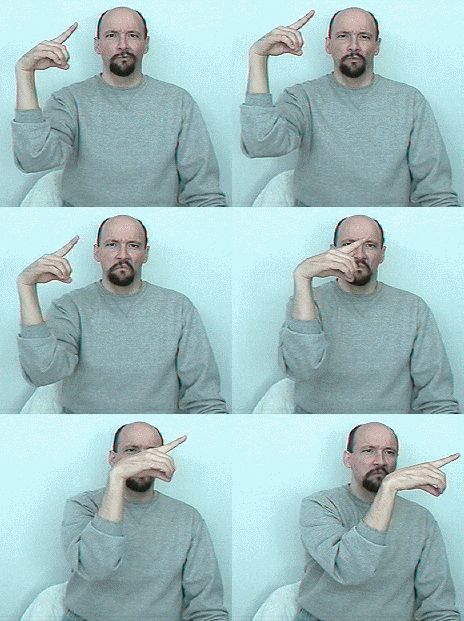
handshape. Below is an example of an older sign for "dinosaur"
which uses a "D" hand (or a
flattened "O"-hand) to show a dinosaur walking past. The arm bounces up and
down a bit (as if taking steps)
as it travels in front of you from one side toward the other while using a
facial expression that conveys something big, heavy, and ominous
walking by.
DINOSAUR-[initialized-version]-[no-longer-recommended]

A common comment in the second decade of the 2K millennium hurled at (some) older initialized signs is "That's Signed English!" However, let me share this bit of insight with you. Thirty years ago (mid-1980's as of this writing) the initialized version of the sign for "dinosaur" wasn't Signed English -- it was just how most of us Deaf people signed it. Now, decades later the movement in the Deaf Community away from initialization has caused many signs to shift from being considered "typical everyday ASL" to instead being considered "Signed English." That is why it is nice to be able to update an ASL dictionary "online" as the language evolves. - Dr. Bill
Sample sentence: DINOSAUR ALL DEAD?
Notes:
Dr. Bill,I have seen two variations on the sign for dinosaur that are different from the one you use. One has the dominant hand's elbow resting on the down-facing, non-dominant hand. The dominant hand has the fingers on the thumb like a closed, flattened "c" formation, but the "head" sways from side to side.The other variation that I saw was where the dominant hand makes a "d" shape, then bounces several times across the top of the head front to back like making "spikes" on the head. Are these widely-accepted variations, or more regional variations?
Thanks,
Kim
[Reply from Dr. Bill, updated
2016/11/08]
Hi Kim,
If you were telling a story about dinosaurs you would likely use a process of introducing the topic and/or establishing context by showing a picture or mentioning a dinosaur movie. If you are in an academic setting you might then fingerspell "dinosaur" or type it on the display (since a student may need to recognize or spell that word on a written (English-based) test later. Then you'd show the two-handed formal sign for dinosaur using the "flattened O" handshape and the palm-down flat base hand. Then, after your have context (it is established that you are discussing dinosaurs) you can drop the base hand and start using the dominant hand to show (depict) what that dinosaur is "doing." (Eating leaves from a tree, fighting another dinosaur, walking around, etc.)
If you have whipped out a book with a big picture of a dinosaur and it is obvious that you are talking about dinosaurs you can jump straight to using a depictive sign (with a flattened-O handshape representing the head) -- the base hand is not needed.
Dr. Bill,Thanks for the information. When I would use that to tell children's stories, could that first dinosaur sign be used as (for lack of a better description) a classifier...for making the dinosaur look around, etc.?
- Kim
Yes, exactly! It could (and should).
-- Dr. Bill
Remember: Your local teacher is "right" for the duration of his/her class. Get the grade you want then go out in the Deaf world and see how signing is done in the real world. Also remember, the (so called) "right" sign in one location may not be common in a different region. That is why I say: "Learning to sign without interacting with Deaf people is like trying to learn how to swim without getting in the water."
One option for how to convey the concept of FOSSIL is:
If you want to learn more animal signs, check out:
Notes:
Also see: ANIMALS
Notes: