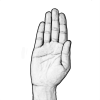
The thumb used in the letter "B" generally has a "slight" bend, but not as much
as depicted in most books. The picture of "B" in my http://asl.ms website was
taken in a series as I was spelling the ABC's. Thus a "B" being produced after
an "A" tends to have less of a bend. If you videotape a Deafie fingerspelling
the word "about" at high speed, the "B" will generally have almost no bend in
the thumb. If you video record the spelling of the term "MBA" the "B" will have
a very acute bend.
-- William G. Vicars, EdD.
"B" Version 1:
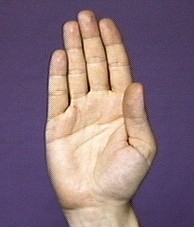
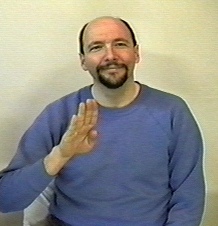
The picture of "B" in my http://asl.ms website was taken in a series as I was spelling the ABC's.
If you videotape a skilled signer fingerspelling the word "about" at high speed, the "B" will generally have little or no bend in the thumb. If you video record that same person spelling of the term "MBA" the "B" will have a very noticeable bend. Here's how I do the letter "B" in general:
-----------------------------------------------------------------------------------------------------------
"B" Version 2:
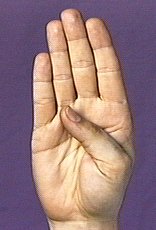
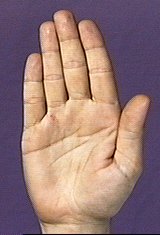
Some people cross the thumb over the palm. I don't do it this way because it
takes too much effort. (Hey, I'm not lazy, just efficient.) This is how
most "books" show it:
Shannon: What is a "b" palm? It doesn't relate to signing the letter "b" right?
DrVicars: When used to describe a sign, a "b" palm is like the letter "b" but you don't have to bend the thumb around onto the palm. The thumb is just alongside the palm in a natural position, with the fingers touching each other (side by side, extended). Think of a traffic cop telling oncoming traffic to stop.
Shannon: Okay that's what I guessed; just wanted to make sure.
"Classifier B," "Flat hand," or "B palm."
This handshape uses a "B" hand with the thumb alongside instead of folded
across the palm. This handshape is used to describe flat, rectangular objects or
surfaces.
Examples: - The roof of a house, a sheet of paper, a table, a box ...
Hello ASL Heroes!!! As you go about watching ASL blogs or videos I
encourage you to occasionally freeze fingerspelled words done on the hands of
skilled signers (native or near-native level) and advance them frame by frame.
For example, just recently Belinda posted a video of Erik Witteborg discussing
diabetes. If you will slow down the video and/or watch it a frame at a time you
might want to take note of how he does the letter "B" when spelling diabetes.
I'll post a pic below for your convenience.
After freezing enough fingerspelled words you will likely come to the conclusion
(as I have) that the way the letter "B" shows up "in real life" on the hands of
skilled signers is significantly different from the mythical ideal typically
shown on fingerspelled alphabet charts (ASL: ABC's) which typically show the
letter "B" done with a bent-thumb across the palm. In real life fingerspelling
done by skilled signers the thumb is rarely bent across the palm to the extent
shown in fingerspelling charts. The actual shape of a "B" handshape is going to
vary widely depending on the preceding letter and the speed of the spelling.
The problem with learning and teaching the "strongly bent thumb" version of "B"
(as shown in most fingerspelling charts) is that doing so creates yet another
(micro) impediment to our students eventually developing fluency. My suggestion?
Relax a little.
Image credit:
(Source: Witteborg, Erik, (December 18, 2018) "Most Risky Food for Type 2
Diabetes?" ASL Health Literacy, Retrieved 1/15/2019 from: https://youtu.be/pwf8Yb0c79A
Time code: 2:18 )
Specific image: https://www.lifeprint.com/asl101/images-layout/b-handshape-sample.jpg
More info: https://www.lifeprint.com/asl101/pages-signs/b/b.htm
Video: https://youtu.be/pwf8Yb0c79A (See 2:18)
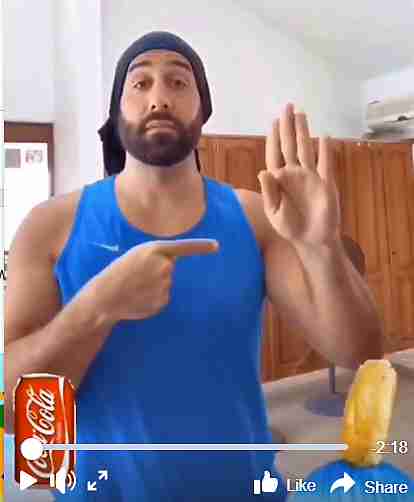
(Source: Witteborg,
Erik, (December 18, 2018) "Most Risky Food for Type 2 Diabetes?" ASL Health
Literacy Retrieved 1/15/2019 from: https://youtu.be/pwf8Yb0c79A Time code: 2:18
)
B
The fingerspelled letter "B."
The myth of the crossed-thumb-B (as "the" right way
to do it).
I received a lot of criticism (some of it was rather condescending) by
various ASL "experts" who wasted no time explaining to others that the
version of "B" I was showing in my chart was (in their opinion which they
stated as if it were fact) wrong.
The version I posted had the thumb pointed upward
in the same direction as the fingers instead of crossing it over the palm.
Why was it that way in the chart?
Because when I spelled the alphabet in the studio that is the version of "B"
that just naturally appeared on my hand having been coarticulated between an
"A" and a "C." Can I tell you a little secret? In real life, at high speed,
native and near-native level signers just plain don't have time to waste
crossing the thumb across the palm when spelling the letter "B" as part of a
real-life fingerspelled word. As with so many other myths beginning level
ASL students are taught -- you can add the myth of the "thumb crossed over
the palm B" as being the "right" way to sign a "B." Instead, the truth or
reality of the matter is that a thumb-crossed-over-the-palm-B is one of the
right ways but not "the only" right way. Let that sink in: A crossed-thumb B is
"a" right way. Not "the" right way. And probably not even the most common
way in real-life native-level adult Deaf high-speed fingerspelling.
----------------------------
Screengrab of a vlog by a d/Deaf ASL content developer, ASL guru, and
long-time member of the Deaf Community named Byron Bridges. This screen grab
is from him spelling his name "Dr. Byron Bridges." Notice that he has a two
B's in his name and thus has a lot of experience spelling the letter "B."
The moment depicted in the screengrab is the closest his thumb came to his
palm while spelling that particular letter "B" (as he spelled the first
letter of his first name).
Dr. Byron Bridges: Spelling "Byron"

(Source: Bridges,
Byron (December 18, 2018) "To CDI or Not," YouTube
channel: deaftendyour, Retrieved 3/10/202024 from: https://youtu.be/Ex2UW2yWIsQ?t=3 Time code:
0:03
)
Notes: