ARE: The
American Sign Language (ASL) sign for "are"
To express the concept of "are" in ASL you don't use a specific sign but
rather you consider what you mean and you choose the sign or set of signs
and grammar features that most closely match your meaning.
Very typically the concept of "are" is expressed as part of a question that
can be answered with a "yes" or a "no." When asking such
questions we raise our eyebrows. So, in a "yes/no"-type question the
concept of "are" is expressed via raising the eyebrows.
"Are you...?" = "raised eyebrows" + INDEX-(pro.1)

For example, if you want to ask "Are you married?"
You would sign "YOU MARRY?" while tilting your head a bit forward and raising your eyebrows.
Another way we can help establish the concept of "ARE" when asking a
question is to repeat the sign YOU at the end of the sentence. For example I
could sign "YOU MARRIED YOU?" People often ask me why some ASL
sentences repeat the sign YOU again at the end of the sentence. The
answer is it depends on how clear you want to be. The same thing
happens in English.
Version 1: "You married?"
Version 2: "Are you married?"
Suppose someone asked you, why do English speakers use the word "ARE" in
version two of that sentence? Does it change the meaning?
You would probably answer that both sentences mean the same, but the second
sentence is a little more formal and clear. In English the question "You
married?" relies solely
on the raising of the tone of voice at the end of the word "married" to
indicate that it is a question, whereas the sentence "Are you married?"
relies on both
the extra word "ARE" and the raising of the tone of voice on the word
married.
Likewise, ASL sometimes repeats the sign YOU at the end of a sentence to
make it clear that you are asking a question and expect an answer.
Here's an example, this time asking about divorce and repeating the sign YOU
at the end.
The concept "ARE" is also expressed in other ways.
For example, if you wanted to say, "There are 15 sandwiches," you could
sign:
"HAVE 15 SANDWICHES"
"Are" = head-nod
If you wanted to say, "They are here." You could sign:
THEY HERE-(head nod).
If you mean "are" as in "indeed" then a good sign to use is the sign is the
sign for "true."
See: TRUE.
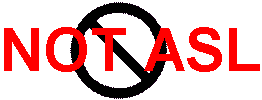
There is a sign in Signed English for the word "are."
That sign places an R-hand at the lips and moves it forward. That sign is
not ASL and I don't recommend it for use on an ASL test nor in the ASL
classroom.
Question:
Marcy writes:
I have been signing this for a long time: ARE with cross fingers, at upper chin
to lips
Some claimed that wrong sign?
Is that sign wrong?
Thanks,
Marcy B.
Response:
Marcy,
The "ARE" sign is considered "Signed English."
If you are teaching an English class or discussing English grammar that sign
can be useful for those limited situations.
In general the "ARE" sign is not considered to be ASL.
Most of the time it can be dropped. Sometimes it can be replaced with the
"TRUE" sign.
For example, to mean "They are coming." -- You could sign:
"THEY COME" (nod your head).
The nodding of the head replaces the need for the English sign ARE.
Warm regards,
Dr. Bill
Notes:
Notes: