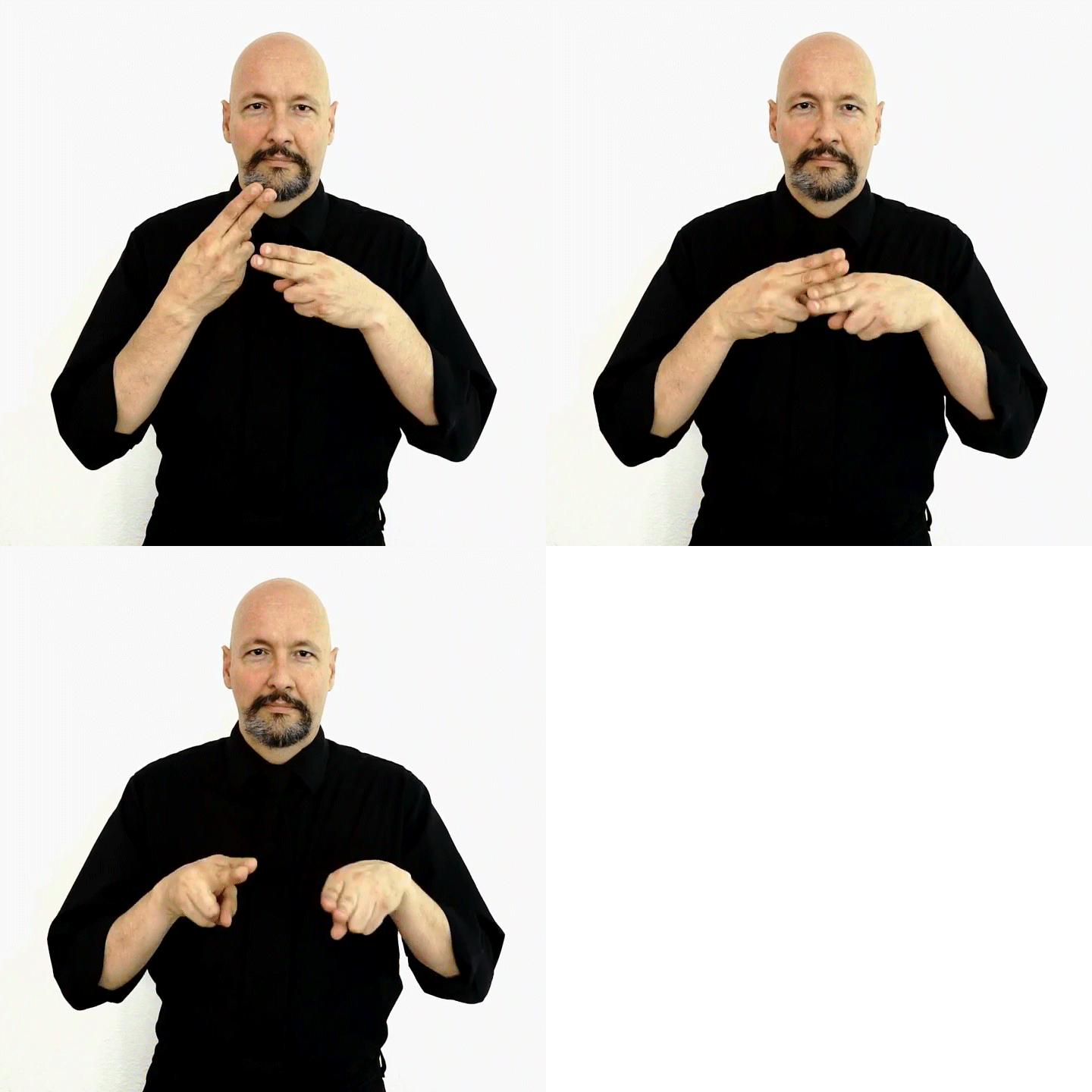
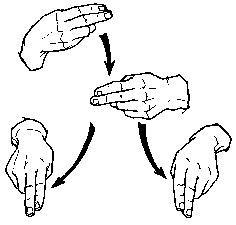
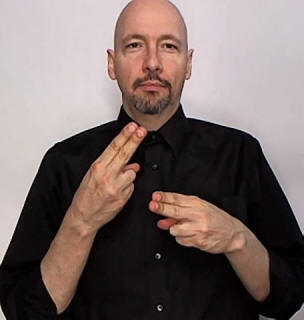
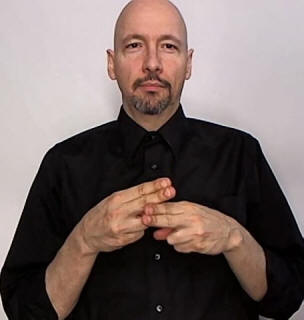
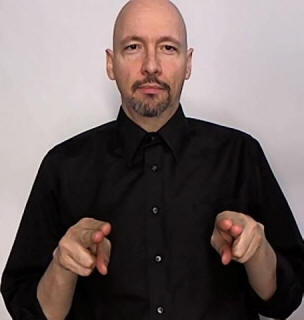
The sign for "egg" is made by forming both hands into the letter "h." In one smooth movement, bring the middle finger side of your dominant "h" hand down on top of the index finger side of your non-dominant "h" hand. Move both hands down and out as if breaking apart an "egg."
EGG:
0:00 / 0:00
EGG Y-O-L-K YOU LIKE SOFT-rt, HARD-lf, WHICH?
0:00 / 0:00
How do you like to cook eggs? = How do you like your eggs?
0:00 / 0:00
SUPPOSE EAT EGG, YOU LIKE KETCHUP YOU?
0:00 / 0:00
Notes:In a message dated 7/28/2003 2:21:54 PM Central Daylight Time, lmurphy@______.com asks:
Dear Dr. Bill,
Does egg follow the noun/verb rule?
Lynne
----------
Lynne,
A double movement is NOT required for this sign to mean the noun "egg."
There is another variation of the sign for egg that uses a "crack" then "split" type movement, but even that variation is still just a "noun" referring to "an egg."
How do that version:
Bring the right hand "h" down onto the left hand "h," then lift the right hand up an inch or so while bringing up the left hand a half-inch and then bring both hands down and apart. This second version is soft of like "cracking and egg and then lifting the egg up a bit to break it apart into your pan.
I sort of like that version, but my wife is standing over my shoulder as I type this.
She said, "No."
And it is obvious she is not open to discussion on this.
Sort of brutal eh?
Anyway, I suppose you could sort of try to make the "H" hand version work as a verb. If you were telling a story about making French toast you could do the sign egg over wherever you put your bowl in the story and it would be understood as "crack an egg into the bowl," but you'd be better off using bent 3 handshapes and mime the cracking of an egg. Under my "crack" page in the signs listing I show the sign for "crack an egg." (An instrument classifier).
- Dr. Bill
Question:
A student writes: Question on "eggs." If you like them over hard/well done -- would you still do the "over easy" sign but kind of showing it faster to show "over hard" or do it as over and then sign for hard or well? Thanks again for the videos :)
Answer:
In regard to the cooking of eggs, if you need to start differentiating between "over-easy, over-medium, and/or over-hard" you would do the flip-over sign and then add one of these options:
FLIP-OVER+
1. spell E-A-S-Y
2. shake an "M" side to side a bit.
3. do the sign for HARD
There are those who will argue that HARD (using the bent-V hand version) is used to mean "hard as in challenging or difficult" -- but in real life we use the sign HARD for a variety of meanings beyond just complex or challenging.
Keep in mind that just because an ASL teacher or some website tells you that the sign for EASY generally applies to something being simple (or "not hard") to do doesn't mean you won't see lots of Deaf folks using the sign EASY to mean "runny yolk." I have no doubt that many Deaf sign "flip-over" + the regular sign for EASY (as opposed to spelling E-A-S-Y.) This is the difference between prescriptive teaching of sign language (telling you what you should do) versus descriptive teaching of sign language (telling you all the messy stuff that is actually being signed in the real world).
Notes: