Also see:
Non-manual
Signals
Non-manual markers consist of the various facial expressions, head tilting,
shoulder raising, mouthing, and similar signals that we add to "signs" (such
as are used in American Sign Language) to create or
influence meaning.
The sign for non-manual markers is to fingerspell "NMM" but
people often do the sign for "expressions" to mean NMM's.
An examples of a non-manual marker:
1. Bringing your cheek and your shoulder closer together while tightening
the muscles in your cheek (as if you were smiling with half your face).
This is often abbreviated as "c-s" meaning "cheek to
shoulder." This non-manual marker is used with signs like,
"RECENT" and "THERE" to mean, "very recent"
and "right there (close)."
Speakers of English tend to inflect their voices to indicate they are
asking a question. Signers of ASL also inflect their questions, but instead
of using voice inflection we use non-manual markers.
For example:
YES/NO Question Expression:
When signing a question that can be answered "yes or no" you
raise your eyebrows and tilt your head forward a bit.
"WH-Q" Question Expression:
When signing a question involving "who, what, when, where, how, how
much, how many, which, or why" you use what is called a "wh"
question facial expression. The "wh" facial expression
"furrows" the eyebrows a bit and may tilt the head back a
bit--while the body might lean forward a bit.
Here are some examples of "wh" question expression:
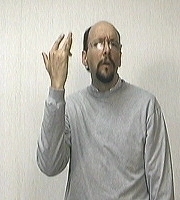 why
why
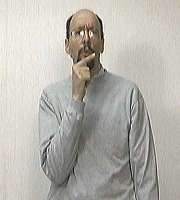 who
who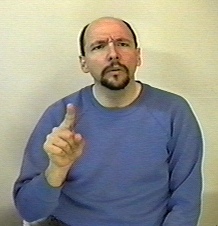 where
where
Nonmanual markers (NMMs) in American Sign Language (ASL) are essential facial expressions, head movements, and other body language cues that convey grammatical information. Here is a list of common nonmanual markers and their descriptions:
- Eyebrows Raised:
- Yes/No Questions: Raised eyebrows are used when asking yes/no questions.
- Conditional Clauses: Raised eyebrows are used to
indicate the conditional part of a sentence.
- Eyebrows Furrowed:
- Wh-Questions: Furrowed eyebrows are used when asking questions that begin with words like who, what, where, when, why, and how.
- Negation and Doubt: Furrowed eyebrows can indicate
negation or doubt.
- Head Nods:
- Affirmation: A nodding head indicates agreement or
affirmation.
- Affirmation: A nodding head indicates agreement or
affirmation.
- Head Shakes:
- Negation: A shaking head indicates negation or
disagreement.
- Negation: A shaking head indicates negation or
disagreement.
- Mouth Shapes:
- "oo": Indicates something small or diminutive.
- "mm": Indicates something regular, normal, or moderate.
- "cha": Indicates something large or big.
- "puffed cheeks": Can indicate something is very large, bulky, or intense.
- "th": Indicates carelessness or a lack of precision.
- "pursed lips": Can indicate intensity or seriousness.
- "gritted / barred teeth": Can indicate effort under
pressure, pain, or intensity.
- Eye Gaze:
- Directional Verbs: The direction of the gaze can
indicate the direction of an action or the subject of the conversation.
- Focus and Attention: Eye gaze can show where the
signer is directing their attention.
- Directional Verbs: The direction of the gaze can
indicate the direction of an action or the subject of the conversation.
- Cheek Puffing:
- Indicates intensity, size, or effort.
- Indicates intensity, size, or effort.
- Nose Wrinkling:
- Can indicate distaste or disapproval.
- Can indicate distaste or disapproval.
- Shoulder Raising:
- Indicates uncertainty or questioning.
- single cheek-to-shoulder indicates "very" or "just" as in "very
recent" or "just happened"
- Head Tilting:
- Used to emphasize a point or to indicate a question.
These nonmanual markers are crucial for understanding and conveying the full meaning of ASL signs, as they add grammatical and emotional context to the manual signs.
Dear Dr. Bill:I used your website to help deaf friends with vocabulary. I am an ASL/Deaf Studies Specialist. I also do computer graphics. I need to know where non-manuals came from? Who gave that idea as a developments. Are there any resources on history of non-manuals signals?Thank you, smileMelinda
Notes: