TEXAS: The ASL sign for "Texas"
To do the sign for "Texas," do an "X" hand on your
dominant hand and move it to the right (if you are right handed, or
left if you are left handed) and down.
It is sort of like drawing a "7" in the air using an
"X" hand.
TEXAS:









Texas (animated)

Texas:
Notes:
A student named David writes:
<<Dr. Bill,
Complete confusion here on my part. The signer isn't you, she isn't using
the "x" hand but the "d" hand, and she isn't moving in a "7" but in a banana
arc. And no explanation of what "7 & x" should convey. My teacher taught the
class "Paris, France" as an Eiffel Towel and that makes sense, but how does "7
& x" convey Texas?
- David
>>
Dr. Bill replies:
Yah...you are right. She isn't me, heh. No plastic surgeon in the world could
pull that off. "Crystil" was a language model I hired many years ago as
part of an interpreter training workshop I was conducting for a school
district. Having lived in Texas for three years I consider myself
somewhat well versed in the sign "TEXAS" but I thought it would be interesting
to show Crystil signing Texas.
Now...the handshape is indeed an "X." She's just doing a very "loose"
X. Her index finger is slightly bent, plus her other fingers are curled in
more than would be done for a "D." The movement is right then down.
Admittedly she is starting farther to the left and doing the sign much higher
than I do.
Allow me to get on my soapbox
for a moment. Signs don't have
to "look-like" anything. Does the English word "bus"
sound (or look) like a bus?
No, the word "bus" is very small, not yellow, and has no wheels
and when pronounced doesn't sound like a bus -- yet English
users continue to use it to refer to something that looks completely
different. Does a "dog" look like a "dog?"
It makes no more sense to use the English word "dog" to
refer to a "dog" than it makes to move an "x" in a "7" shape to mean
"Texas." And that is my point. American Sign Language doesn't
have to be "iconic." ASL signs
don't have to "make sense." They don't have to "look like" the concept they are representing any more than
English words have to "sound-like" the concepts being "talked about."
Hearing people don't say "woof" to mean "dog." They say, "DOG."
If you took English classes when you were in school, I bet you didn't tell
your English teacher that the word Texas didn't make sense. You didn't tell
her that the word should be "bigger" (longer) since Texas is a big state.
Deaf people don't have to use a "T" from English to represent their sign in
ASL for TEXAS. The sign Texas doesn't have to map to English whatsoever. The sign "TEXAS"
means "Texas" because of "convention" (ASL users recognize it and use it because others use it).
 But, since
I know that it helps Hearing people to learn (acquire, categorize,
store, and retrieve) signs if the signs have a "story" of origin
(particularly a story that connects to their existing knowledge of English), I'm going to
share with you what I was told by a person named Erin from Corpus
Christi, Texas. According to her instructor down in Texas, the movement
of the TEXAS sign represents the "panhandle" of Texas.
But, since
I know that it helps Hearing people to learn (acquire, categorize,
store, and retrieve) signs if the signs have a "story" of origin
(particularly a story that connects to their existing knowledge of English), I'm going to
share with you what I was told by a person named Erin from Corpus
Christi, Texas. According to her instructor down in Texas, the movement
of the TEXAS sign represents the "panhandle" of Texas.
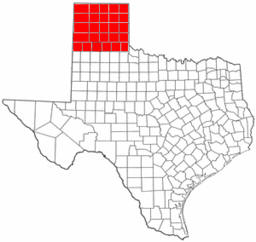
Take a look at the graphic on the left, (courtesy of Wikipedia and
the Texas State Historical Association). The red area is considered to be
the "panhandle" of Texas. Notice how "square" it is? Notice the
"across and down" outer perimeter?
The "X" handshape in the sign TEXAS is based on the
'x' in Te'X'as. Also note that Texas is the only
state with an 'x' in it's name.
So, ta-da! You now have a perfectly
good memory aid for why Texas is signed the way it is.
Is that "really" the "right" explanation of the origin of the sign for Texas?
(Is it the right "etymology?") Maybe. Maybe not.
The fact is many "place or location" signs tend to use that same
"square" or "7" type movement. It is so common as to be a
"default" generic movement path for city name signs.
Some people say that the reason why location signs use the "across
and down" movement path is because buildings in cities are flat on
top and have sides that go straight down.
But hey, if the "panhandle" / "X" explanation helps get you through
your next ASL test with an "A" grade then BOOYAH!!!
Mission accomplished!
-- Dr. Bill
Another example, this time from Deaf ASL instructor (and golf
player!) Byron Cantrell:
TEXAS:



(Model: Byron Cantrell)
Note: Check out that mouth morpheme!!! Byron (native Deaf) is literally
forming a specific mouth shape as part of his version of the sign
for Texas!
*
Want to help support ASL University? It's easy:
DONATE (Thanks!)
* Another way to help is to buy something from Dr. Bill's "Bookstore."
* Want even more ASL resources? Visit the "ASL Training Center!" (Subscription
Extension of ASLU)
* Also check out Dr. Bill's channel:
www.youtube.com/billvicars
You can learn American Sign Language (ASL) online at American Sign Language University ™
ASL resources by Lifeprint.com © Dr. William Vicars