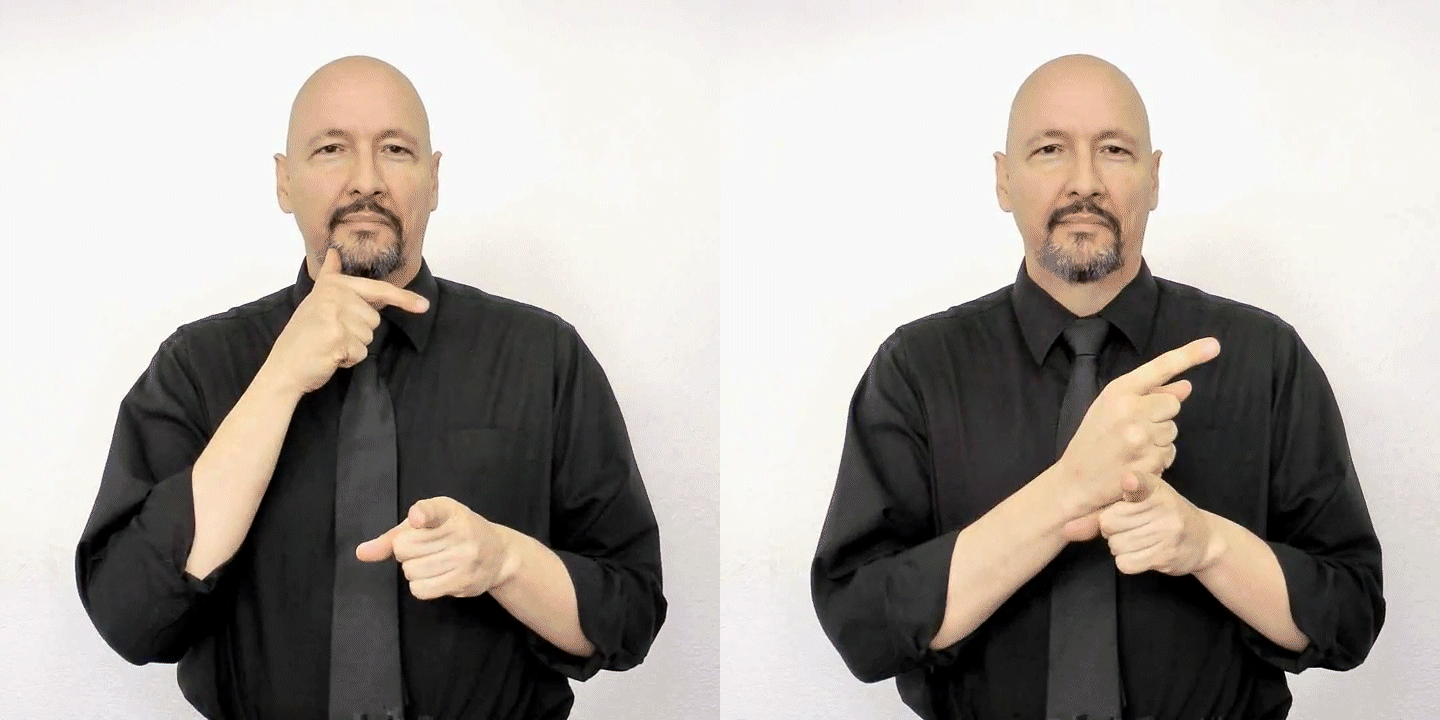
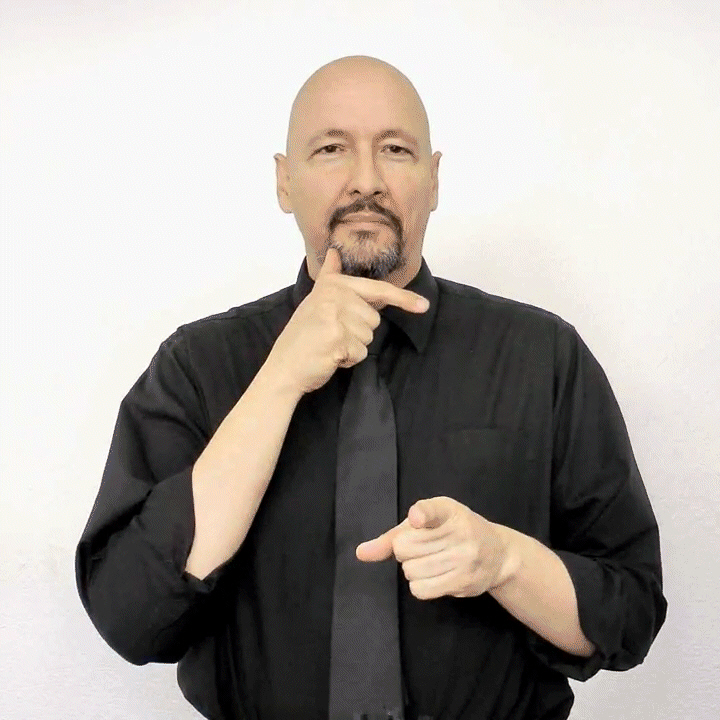
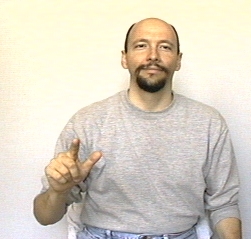
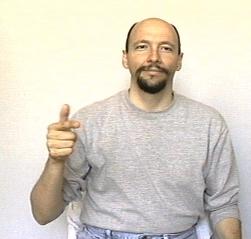
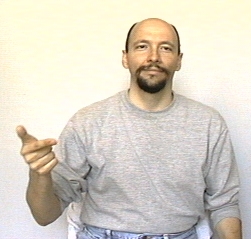
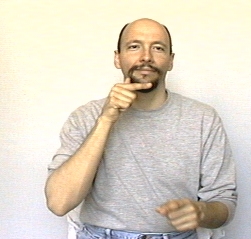
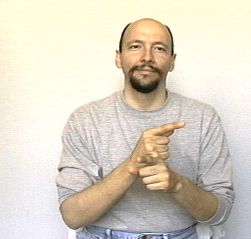
The sign for sister is basically a combination of the signs "GIRL" and "RIGHT."
The dominant hand of "SISTER" starts
with somewhat of an "L" handshape.
The handshape is a cross between
a "G" and an "L.") The right hand changes to a normal
"G" handshape as it moves downward and makes contact with the
non-dominant hand which is already in an "index finger / G handshape." The
dominant hand is the one that moves. The non-dominant hand is stationary during
this sign.
SISTER:
There is another version of the sign for "sister" that I don't recommend because
it is considered to be "Signed English" by many people. I don't think it
is Signed English. I just think it is the "older" version of the current
sign for "sister." This version of "sister" uses a combination of the signs "GIRL"
and a version of the sign for "SAME-(also, too). I believe that over time
the second part of the sign mutated from "SAME/also, too) into the sign "RIGHT"
because it is slightly easier and faster to use
Even though I wouldn't recommend it for an ASL class, I believe it is worth
knowing (especially for interpreters) because you might see it used in the Deaf
community.
Tip: When trying to remember the sign for brother or sister, remember
that the
boy and/or girl come
from the same family.
There is an interesting sign for "step-sister" that is a combination of the sign for "his-TURN"
(or "SECOND-HAND") and "SISTER." Some people use this sign others don't.
I like the sign and I feel it is as good as any other signs for the concept. The
sign "SECOND-HAND" can be used to indicate "next one" as it is here.
STEP-SISTER (version)
Other methods of indicating "step"
(as in "step-sister) include fingerspelling S-T-E-P, or signing
"false." But I prefer to use the sign "false-sister" to mean
"foster sister."
ADDITIONAL reading (not required)
In a message dated 1/18/2004 3:54:39 PM Pacific Standard Time, a student
writes:
I am an Interpreting student at Columbus State Community College in
Ohio. I am also the mother of a 25 year old Deaf son. I first learned Signed
English, which is what I raised and taught my son to communicate with; he began
attending the Ohio School for the Deaf at 13, where he of course became
introduced to ASL. He has only recently (at my insistence) began using ASL when
talking with me; because for so long I did not know ASL, but I did notice that
sometimes when he was signing with friends or other Deaf people, it looked alot
different than my signing, and I didn't always follow it! I am finally starting
to think "visual" instead of word for word English signing, but I still find
myself slipping into English in long conversations, but I'm working on that, and
I now that I understand ASL better, I really think its a beautiful and intense
(for lack of a better term) language.
I was just browsing Lesson 2,
I came across your sign for "Step Sister"; I have never seen this before, and
I'm not quite sure about what your hands are doing in the first step where you
said it represents "his turn". Could you possibly elaborate on the handshape and
movement of this part, I get the ending "sister" shape/movement. I know the sign
I use for "turn" is like a palm-down 'G' shape that twists clockwise into the
basic 'G' shape; is this what you mean? As I said, I have never seen this nor
any other version of a "step" sign added to a family category, other than
"half", "not real" or fingerspelled S-T-E-P. So I'm quite curious, and excited
to learn a new sign for this concept!
Get back to me when you have time, I know you must be busy! Thank you for
sharing your wealth of information with me and everyone else! God Bless you!
Sincerely,
-
Lynn Platt
Hi Lynn,
The movement in the "secondhand" or "turn" version of "step" in step sister is a
cross between turning a screwdriver and casting a fishing line. The whole
movement is fairly quick. The handshape is a relaxed "L" and/or "G."
- Dr. Bill
Want to help support
ASL University? It's easy:
DONATE (Thanks!)
(You don't need a PayPal account. Just look for the credit card
logos and click continue.)
Another way to help is to buy something from the ASLU "Bookstore."
Want even more ASL resources? Visit the "ASL Training Center!" (Subscription
Extension of ASLU)
CHECK IT OUT >
Bandwidth slow? Check out "ASLUniversity.com" (a
free mirror of
Lifeprint.com less traffic, fast access)
VISIT >